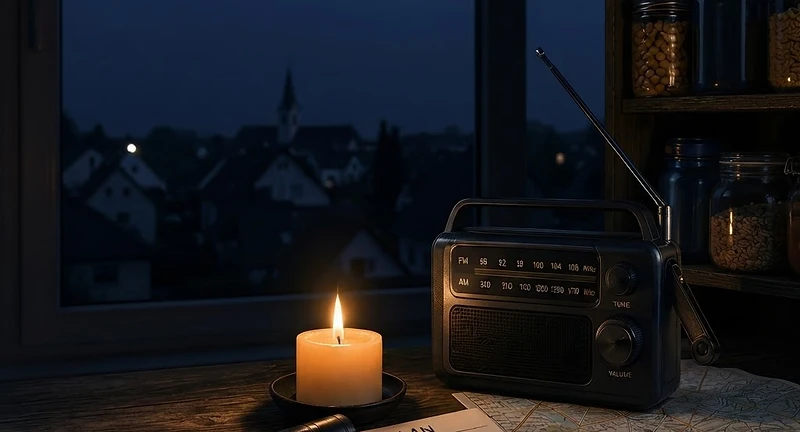
When the lights go out, the modern world stops with them. Electricity, water, digital banking, and even the supermarket shelves all rely on a delicate, invisible grid. Most European households are fundamentally unprepared for a sustained disruption, yet the risks, from extreme weather to infrastructure failure, are no longer hypothetical. This is not a survivalist manifesto filled with fear and bunker-building instructions. Instead, it is a grounded, expert-led guide for the average person living in a flat or a terraced house. You will learn how to build real resilience without expensive equipment or lifestyle extremes. Discover how to secure your food supply, maintain essential utilities, and prepare your household for the gaps between a crisis and the government's response. Stop waiting for someone else to keep you safe and start building a plan that works even when the systems fail. Will you be ready when the grid turns dark?
✦Practical resilience for real life: Gain essential skills tailored for flats and houses without expensive gear.
✦Expert clarity, not fear: Replace panic with a grounded, actionable plan to handle modern infrastructure failures.
✦Bridge the gap: Learn how to manage the critical hours before government aid arrives during a crisis.
If you enjoyed The Knowledge by Lewis Dartnell or The Uninhabitable Earth by David Wallace-Wells, you will love the grounded, essential insights in this book.
Get the Book
Bought this book? Claim your free eBook
If you have already bought When the Lights Go Out by David Oldham, tell us where to send it and we will email you the eBook version, free. You keep reading on any device.
Chapter 1: The
Seventy-Two Hour Lie
On 28 April 2025, at exactly 12:33 in the afternoon, fifteen
gigawatts of electricity vanished from the Iberian Peninsula.
Sixty per cent of Spain's power generation disappeared in a
matter of seconds. The grid frequency plummeted. Protection
systems tripped. And within six seconds, every power line
connecting Spain and Portugal to the rest of Europe was
automatically disconnected.
The lights went out across two entire countries.
Trains stopped in tunnels. Traffic lights died at intersections
across Madrid and Barcelona. Lifts froze between floors.
Hospitals switched to backup generators, the ones that worked.
Internet connections dropped. Mobile phone networks
collapsed under the weight of millions of people
simultaneously trying to find out what had just happened.
Payment terminals in shops, petrol stations and restaurants
went dark. In Madrid alone, emergency services carried out
286 operations to free people trapped in lifts.
15
It lasted up to ten hours in some areas. The expert panel that
investigated it, reporting in March 2026, called it the largest
and most severe blackout in the European electricity system in
over twenty years. There was no single cause. It was, in their
words, a perfect storm of multiple factors, including the grid's
inability to control voltage peaks, a lack of real-time
monitoring, and safety margins that were thinner than anyone
had publicly admitted.
Nobody attacked Spain. Nobody hacked the grid. Nobody
pressed a button. The system simply failed, the way complex
systems do when they're running close to their limits and
nobody's watching the dials closely enough.
Now imagine someone had been trying.
Here is the uncomfortable truth that every government in
Europe now quietly acknowledges but none of them want to
say out loud: if something goes seriously wrong, you are on
your own.
Not permanently. Not forever. But for the first 72 hours, and
probably longer, the state will not be coming to save you. The
emergency services will be overwhelmed. The supply chains
will be disrupted. The infrastructure you depend on for
everything from heating your home to flushing your toilet will
be degraded or gone. And the government's honest advice,
when you strip away the reassuring language, is that you should
have been ready for this before it happened.
When the Lights Go Out
16
The Swedes, to their credit, are at least honest about it. In
November 2024, the Swedish Civil Contingencies Agency
began posting 5.2 million copies of a booklet called “If Crisis
or War Comes” to every household in the country. It was the
sixth edition of a pamphlet the Swedish government has been
issuing since the Second World War, updated for the first time
in six years, and this time with a notably stronger focus on the
possibility of armed conflict. Sweden's former army chief,
Micael Bydén, had already set the tone earlier that year when
he told his compatriots, bluntly, that they needed to mentally
prepare for war.
The booklet covers what to do during power cuts, water
shortages, air raids and communication blackouts. It tells
citizens where to find their nearest shelter. It explains that
everyone in Sweden between the ages of 16 and 70 is part of
the country's total defence and is obligated to contribute in the
event of conflict. And it contains a single sentence that should
probably be printed on the front page of every newspaper in
Europe: “If Sweden is attacked, we will never surrender.”
Finland, sharing an 830-mile border with Russia, launched its
own crisis preparedness website on the same day. Half a
million Finns had already downloaded an emergency
preparedness guide. Norway and Denmark had distributed
updated guidance earlier in the year. Germany updated its
Framework Directive for Overall Defence in June 2024 and
started developing an app to help citizens locate their nearest
bunker.
When the Lights Go Out
17
And Britain? Britain has a website.
The United Kingdom's approach to civilian preparedness is, to
put it charitably, thin. There is no pamphlet. There is no
booklet through the letterbox. There is no equivalent of
Sweden's clear, direct, slightly alarming instruction manual for
what to do when things go wrong. There is GOV.UK/Prepare,
a web page with some sensible but remarkably vague advice
about making a household plan, adding emergency contacts to
your phone, and learning first aid.
The disconnect between what the government knows and what
it tells the public is staggering. The 2026 National Risk
Register, published in July, lists 95 separate risks facing the
United Kingdom. Ninety-five. They include national power
outages, water infrastructure failures, cyberattacks on critical
systems, disruption to data infrastructure, pandemics, terrorist
incidents, major flooding, and, in a telling addition, the risk of
interference in the UK's democratic process. Seven new risks
were added in this edition alone, including several categories
of cyber threat that didn't appear in previous versions.
The government simultaneously announced plans for
Operation Albiston Shadow, described as the largest UK home
defence exercise in decades, to be conducted in 2027 and
involving ministers and hundreds of officials testing
preparedness for hybrid attacks against the UK. The armed
forces minister stated in July 2026 that Russia is a direct threat
When the Lights Go Out
18
to the UK homeland. The Defence Secretary told the Labour
conference that Britain faces a greater risk of war than at any
point in his lifetime.
And then they told the public to check a website and maybe
talk to their neighbours.
In the Cabinet Office's own 2026 preparedness survey, just 13
per cent of households described themselves as largely or
totally prepared for an emergency. Fifty per cent said they
were slightly prepared or not at all prepared. Those numbers
were virtually unchanged from 2025, which tells you exactly
how effective the government's communication strategy has
been.
Lord Harris, the chair of the National Preparedness
Commission, put it with admirable clarity when he argued that
Britain needs a culture where households understand that no
one may arrive quickly to fix things when a crisis hits. He is
right. And the fact that this still needs saying in 2026, after a
pandemic, after watching a European war unfold in real time,
after watching the Spanish grid collapse live on television, tells
you everything you need to know about the gap between what
the state knows and what it has bothered to share with you.
This is not, incidentally, a new problem. Britain once had a
serious civilian preparedness infrastructure, from the wartime
ARP service to the Cold War Civil Defence Corps, and
systematically dismantled all of it. How that happened, and
When the Lights Go Out
19
why it matters, is the subject of the next chapter. But the result
is a country that has spent more than fifty years operating on
the assumption that modern infrastructure is robust, that the
state can handle whatever comes, and that telling people to
prepare for the worst would be alarmist and politically
damaging.
That assumption is now visibly, demonstrably wrong.
The risks facing Europe in the mid-2020s are not theoretical.
They are documented, assessed, and in many cases already
happening. Cyberattacks on logistics networks increased by
965 per cent between 2021 and 2025. Europe experienced an
estimated 43 billion euros in losses from heat, drought and
flooding in the summer of 2025 alone. The 2026 Allianz Risk
Barometer identified global supply chain paralysis due to
conflict as the most plausible near-term catastrophic scenario,
with 51 per cent of respondents considering it a realistic
possibility within five years. And between 2025 and 2026, the
share of British people who thought war was likely to affect
their local area within two years rose from 19 per cent to 28
per cent.
These are not the numbers of a stable, secure continent. These
are the numbers of a continent that is slowly waking up to the
fact that the post-Cold War holiday is over. Part Two of this
book examines the specific threats in detail: the electricity
grid, the food supply, the digital infrastructure, and the
When the Lights Go Out
20
slow-burning crises that don't arrive with a bang but erode the
ground beneath your feet.
So what does all this mean for you, specifically?
It means that the governments of Europe have collectively
decided, some more openly than others, that you need to be
able to look after yourself and your household for at least 72
hours without any outside help. No mains electricity. No mains
water. No functioning shops. No mobile phone signal. No
internet. No emergency services at your door within minutes.
That's the official line. The unofficial reality, as anyone who
watched the aftermath of the Iberian blackout or the UK's
recent flood responses could tell you, is that 72 hours is
optimistic. In a serious, widespread disruption, it could easily
be a week. In parts of the country with poor infrastructure,
limited emergency services, or remote geography, it could be
longer.
This is not paranoia. This is not prepping in the tinfoil-hat,
bunker-mentality, American survivalist sense. This is the
considered assessment of the governments you elected, the risk
analysts they employ, and the military commanders who advise
them. The Swedes are telling you to prepare for war. The
Germans are mapping bunkers. The Finns have a website that
half a million people have already used. The British
government lists 95 separate risks in its National Risk Register
When the Lights Go Out
21
and then suggests you add some emergency contacts to your
phone.
The question is not whether disruption is coming. The question
is whether you'll be ready when it does. And the honest
answer, for most European households right now, is no. Not
even close.
This book is about changing that.
When the Lights Go Out
22
When the lights go out, the modern world stops with them. Electricity, water, digital banking, and even the supermarket shelves all rely on a delicate, invisible grid. Most European households are fundamentally unprepared for a sustained disruption, yet the risks, from extreme weather to infrastruct
Who wrote When the Lights Go Out?
When the Lights Go Out was written by David Oldham.
What genre is When the Lights Go Out?
When the Lights Go Out is categorized as Self-Help, Politics, Nature & Environment.
Where can I buy When the Lights Go Out?
When the Lights Go Out is available for purchase on Other.
How many pages is When the Lights Go Out?
When the Lights Go Out has 209 pages.
When was When the Lights Go Out published?
When the Lights Go Out was published on October 14, 2026 by D&H Publishing International Ltd.
Can I read a sample of When the Lights Go Out?
Yes, you can read a free sample of When the Lights Go Out on AuthorCentral. An excerpt is available on the book page.