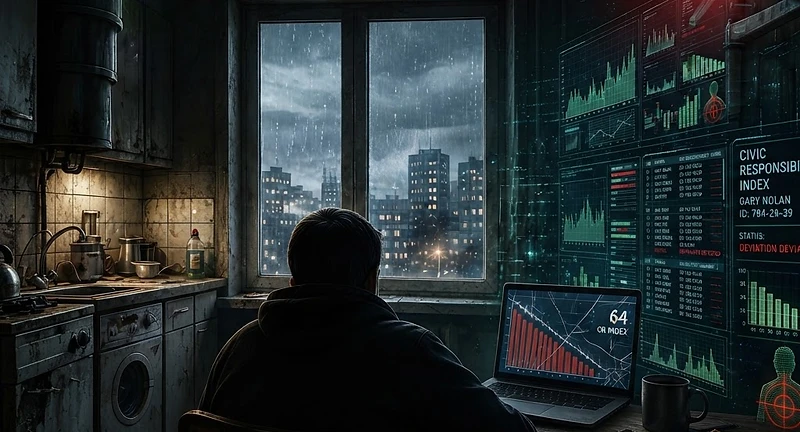
Gary Finch is not a rebel. He is a facilities maintenance worker who fixes boilers, rewires plugs, and burns his toast most mornings because his mind is elsewhere. He is exactly the kind of ordinary, overlooked citizen the system is built to ignore. But when Gary starts paying attention to his Civic Responsibility Index, the government-mandated score that quietly governs every aspect of modern British life, he notices something nobody else seems to see: the numbers do not add up. Behind the reassuring blues and greens of the EquiLine platform, behind the friendly language about community contribution and positive trajectories, an algorithm is making decisions about who gets to work, who gets watched, and who gets corrected. It is quietly, systematically, closing in on people. Starting with him. As Gary digs deeper into a system designed to be too complicated for ordinary people to question, he uncovers a machine that rewards silence and punishes curiosity, one that has already flagged him as a deviation worth monitoring. His daughter thinks he is being paranoid. His neighbours think he is being difficult. The system insists he is simply a citizen with a declining score and no cause for alarm. But Gary knows what a warning light looks like, even when it is disguised as a dashboard. Deviation Detected is a chilling, slow-burn thriller about surveillance, conformity, and the terrifying ordinariness of a dystopia that arrives not with sirens, but with soothing customer service language and quarterly reviews. It asks a simple, unsettling question: what happens when the only person who notices the danger is the one person nobody is listening to? For readers who loved the creeping dread of Black Mirror and the institutional menace of dystopian classics, this is a story about the quiet erosion of freedom, one flagged citizen at a time.
✦A terrifyingly plausible near-future where your worth is a number on a dashboard
✦An everyman hero whose only crime is paying attention
✦Slow-burn dread that builds from burnt toast to full-blown surveillance state horror
Fans of George Orwell's 1984 and Dave Eggers' The Circle will recognize the creeping institutional menace at the heart of this story, while the tone and pacing echo the unsettling near-future paranoia of Black Mirror. Readers of Cory Doctorow's Little Brother will appreciate the ordinary protagonist standing against an algorithmic system designed to make dissent invisible.
Get the Book
The toast was burning again.
Gary Finch could smell it from the hallway, that acrid sweetness of bread turning to carbon, and he knew without looking that the timer had gone off at least a minute ago. He could picture the kitchen exactly: the toaster glowing orange on the worktop, the crumbs scattered around its base like a tiny archaeological dig, the laptop open beside it with its cracked screen casting a pale light across the Formica. He could picture all of this because it was the same scene every morning, because Gary Finch was a man of routines, and because the toast burned most days now. Not through neglect, exactly. Through distraction.
He padded into the kitchen in his socks, the lino cold under his feet, and popped the toast. Two slices of Warburtons, both charred on one side and barely touched on the other because the toaster had been pulling to the left since March and he kept meaning to look at it. He was a man who fixed things for a living. He could strip a boiler, re-hang a fire door, repoint brickwork, rewire a plug. But his own toaster had been cooking unevenly for five months because there was always something more interesting to think about.
He dropped the toast onto a plate, scraped the black bits into the sink, and sat down at the kitchen table in front of the laptop. The crack ran diagonally across the screen from the bottom left corner, a thin fracture that split the display into two slightly misaligned halves. Leah had offered to buy him a new one for Christmas. He had said no, the way he always said no to gifts, because accepting things from his daughter felt like admitting he could not manage on his own, and Gary Finch could manage on his own. He had been managing on his own for six years, since Karen left, and he was fine. The house was fine. The toast was fine.
The toast was not fine. He ate it anyway.
On the screen, the Civic Responsibility Index portal glowed in its municipal blues and greens. He had been on this page for twenty minutes before the toast distracted him, and he had been on it for roughly an hour the night before, and most of the previous evening, and several times during his lunch break at work. The portal was designed to be simple. That was the word they kept using in the introductory materials: simple. Your score, your neighbourhood, your contribution. Three tabs across the top, a dashboard that looked like something from a banking app, and a number in the centre of the screen in a font large enough to read without his glasses.
Sixty-four.
Gary looked at the number the way he looked at a boiler pressure gauge that was reading slightly outside its normal range. Not alarmed. Not yet. But attentive. Something about it did not sit right. He could not have told you what the number should be, because nobody had ever explained what a good score looked like, not really. The launch materials had been full of encouraging language about civic engagement and community contribution and positive trajectories, but they had been notably thin on specifics. Nowhere did it say: this is a good score and this is a bad one. You were simply given a number and left to feel however you felt about it.
Gary felt uneasy.
He clicked the neighbourhood tab. This was one of the features the government had promoted most heavily during the rollout: transparency. You could see aggregate scores for your street, your ward, your postcode. The idea, according to the...
Gary Finch is not a rebel. He is a facilities maintenance worker who fixes boilers, rewires plugs, and burns his toast most mornings because his mind is elsewhere. He is exactly the kind of ordinary, overlooked citizen the system is built to ignore. But when Gary starts paying attention to his Civic
Who wrote Deviation Detected?
Deviation Detected was written by David Oldham.
Where can I buy Deviation Detected?
Deviation Detected is available for purchase on Amazon UK, Amazon US.
How many pages is Deviation Detected?
Deviation Detected has 329 pages.
When was Deviation Detected published?
Deviation Detected was published on September 21, 2026 by D&H Publishing International Ltd.
Can I read a sample of Deviation Detected?
Yes, you can read a free sample of Deviation Detected on AuthorCentral. An excerpt is available on the book page.