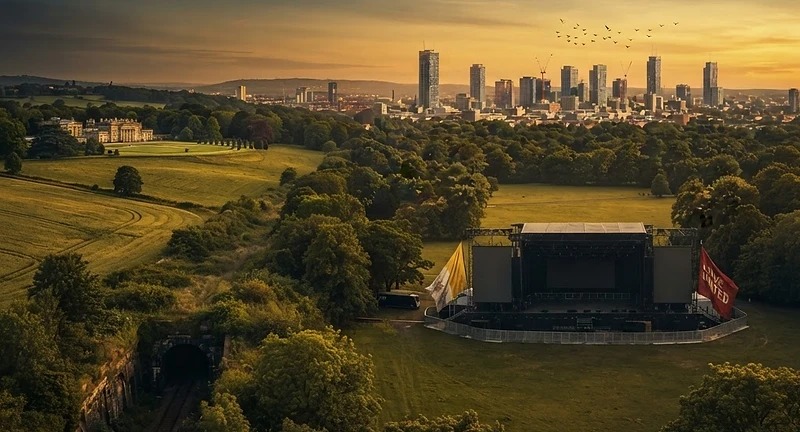
For six hundred acres of rolling parkland in north Manchester, the question has always been the same: what is it about this place? David and Helen Oldham set out to answer it in this vivid, meticulously researched history of Heaton Park, tracing its journey from medieval farmland and aristocratic estate to the beating heart of a modern city. Along the way they follow the Egertons and their neoclassical hall, the racecourse that helped give birth to the Grand National, the railway tunnel forced beneath the estate, and the public campaign that rescued the park from developers in 1902. From there the story moves through the Manchester Pals training in its fields, the RAF processing thousands of aircrew, families housed in postwar prefabs, and a quarter of a million pilgrims gathering for Pope John Paul II in 1982. It carries through to the Commonwealth Games bowls competition, the Stone Roses, Oasis, and the roar of Parklife. Written with warmth, rigor, and an insider's eye for the stories Mancunians tell about their own city, this book does not simply celebrate Heaton Park's popular myths, it tests them. The authors separate solid evidence from tales that have grown taller in the telling, including the famous claim about Europe's largest municipal park. What emerges is something better than a record: a portrait of a landscape that has absorbed every demand a changing city could place on it, and asked in return only that it be remembered properly. Whether you know the park from Sunday walks around the boating lake or from a night spent in a festival crowd, this book will change how you see it.
✦Debunks the myths, from Europe's largest park claim to the Grand National connection, with real evidence
✦Brings together popes, punk festivals, Pals battalions, and prefabs in one sweeping local history
✦Told partly through the author's own unforgettable night selling papal flags outside the park gates
If you enjoyed The Matchbox That Ate a Forty-Ton Truck by Marek Kohn or the local-history storytelling of Bill Bryson's At Home, you will love this book, and readers of Peter Ackroyd's London: The Biography will recognise the same instinct for reading a whole city's history in a single place.
It was the flags that did it. Not the Pope, not the helicopters, not the quarter of a million people who would fill every corner of Heaton Park by morning. It was the flags.
Yellow and white. Papal colours. Cheap fabric on wooden sticks, three thousand of them, bundled into boxes and stacked against the wall on the corner of Kings Road and Bury Old Road. My mate Geoff Goodman had got hold of them from a warehouse in Strangeways, the way you did when you were young and had more nerve than sense, and we stood there as the evening drew in, ready to make our fortune.
We had no idea what was coming.
The first coaches arrived while it was still light. One or two at first, then a steady stream, then a procession that seemed as though it would never end. They came from every direction. From Rochdale and Oldham, from Bolton and Bury, from Wigan and Warrington, from places I had never heard of and would never visit. They came from Ireland and Scotland. They came from Poland. Coach after coach after coach, headlights cutting through the dusk, air brakes hissing as they pulled up along Bury Old Road, and out poured thousands upon thousands of people, all heading in the same direction, all carrying the same look on their faces. Something between excitement and disbelief. As if they could not quite believe that this was really happening. Not here. Not in Manchester.
And all of them wanted a flag.
Thirty pence each. That was the price. And Geoff and I sold them as fast as we could hand them over. There was no such thing as digital money in 1982. No card readers, no contactless, no phone payments. Just coins. Tens and twenties and fifties pressed into our palms, hour after hour, until our jacket pockets were dragging on our shoulders and our trouser pockets were sagging at the knees. The crowd kept coming and the flags kept going and the noise kept building, that low hum of a vast gathering finding its voice, a sound that starts in the chest before it reaches the ears.
Three thousand flags. By midnight every last one of them was gone, and we had nothing left but pocketfuls of copper and silver and nowhere left to put it.
It was the night of 30 May 1982. The following morning, Pope John Paul II would arrive at Heaton Park to celebrate Mass and ordain twelve men to the priesthood. It was the first time a reigning pope had visited Britain. Elsewhere, the Falklands War was reaching its climax, British forces closing in on Port Stanley. The Cold War ground on. Northern Ireland smouldered. And here, in a municipal park in north Manchester, a quarter of a million people were gathering in the darkness for something that had nothing to do with any of that.
I was not Catholic. Neither was Geoff. We were there to sell flags. But you did not have to be a believer to feel what was in the air that night. Something bigger than the event itself. A sense that this park, this enormous stretch of green on the edge of a city that had seen better days, was the kind of place where extraordinary things happened. Where they had always happened.
By the time the morning came I was finished. The crowd had swelled into something vast and unimaginable, a sea of yellow and white stretching across the park in every direction, but I could barely keep my eyes open. While a quarter of a million people stood waiting for the moment of their lives, I was flat on my back on a park bench, completely spent. I had been on my feet all night and my body had simply given up the argument.
Then a noise went through the crowd. A ripple that became a roar. The Pope was here. The helicopter had come in, and the Popemobile was making its way into the park. I dragged myself upright, caught a glimpse of John Paul II through the press of bodies and the forest of raised flags, the same flags we had been selling hours earlier, and that was enough for me. I had seen the Pope. I turned around and walked home to Rainsough on feet that barely worked, pockets still heavy with coins, leaving 250,000 people to their Mass.
I did not know it then, but that night on the corner of Kings Road and Bury Old Road was the start of a question I would not get around to asking for another forty years. What is it about this place?
Heaton Park covers about 600 acres of rolling parkland in the north of Manchester. It is often called Europe's largest municipal park, a claim that does not survive close examination but tells you something about how the city feels about it. Sutton Park in Birmingham is nearly four times the size. Madrid's Casa de Campo could swallow it six times over. But Heaton Park carries a weight that has nothing to do with acreage.
For six hundred acres of rolling parkland in north Manchester, the question has always been the same: what is it about this place? David and Helen Oldham set out to answer it in this vivid, meticulously researched history of Heaton Park, tracing its journey from medieval farmland and aristocratic es
Who wrote Heaton Park?
Heaton Park was written by David Oldham, Helen Oldham.
Where can I buy Heaton Park?
Heaton Park is available for purchase on Other.
When was Heaton Park published?
Heaton Park was published on September 26, 2026 by D&H Publishing International Ltd.
Can I read a sample of Heaton Park?
Yes, you can read a free sample of Heaton Park on AuthorCentral. An excerpt is available on the book page.