
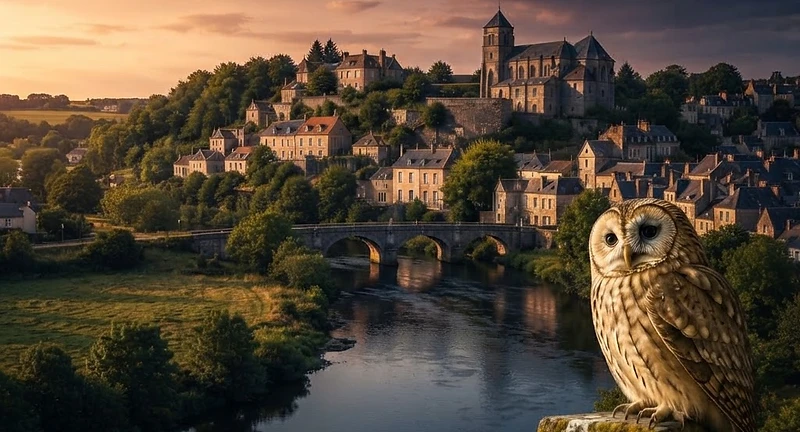
The River & The Owl

The River & The Owl

Touring Mayenne Through the Ages

There is a corner of France that most travelers drive straight through without a second glance, a quiet department wedged between Brittany, Normandy, and the Loire that has somehow slipped off the tourist map entirely. The River & The Owl is the first English-language guide to give Mayenne the attention it has long deserved, and the result is a book unlike any conventional travel guide on the shelf. Written by David and Helen Oldham, who abandoned Britain for a village of fewer than a thousand souls in northern Mayenne, this book blends deep historical narrative with practical, drivable, walkable, and cyclable routes that let readers step directly into the story. Beginning four hundred thousand years ago in the painted caves of the Erve Valley and ending in the Saturday markets of today, the book moves chapter by chapter through the Roman city hidden in the bocage, the medieval fortress that held off William the Conqueror for years, the linen wealth of Laval, the bloody Wars of Religion, the extraordinary Chouannerie uprising led by a man who could imitate an owl's cry, a Marian apparition witnessed only by children on the eve of a war's end, and a startling roster of visionary painters, playwrights, and sculptors born in this overlooked soil. Each chapter closes with a detailed route, distances, timings, and honest practical advice, making this as useful in the car as it is by the fireside. Mayenne is not Provence, and the authors never pretend otherwise. It is something rarer: an undiscovered slice of the real France, told with warmth, wit, and the authority of people who buy their vegetables from the people who grew them.
  • ✦A genuine discovery: the first English guide to a department France itself has overlooked
  • ✦Deep, absorbing storytelling paired with practical routes you can drive, walk, or cycle
  • ✦Unforgettable characters, from an owl-calling rebel to a customs man who painted jungles from imagination

If you enjoyed A Year in Provence by Peter Mayle or The Discovery of France by Graham Robb, you will love this book, and readers of Bill Bryson's travel writing will appreciate its wry, observant voice applied to a corner of France that has never had its story told in English before.

Meet the Authors

Get the Book

I did not come to Mayenne on purpose. Nobody does. If you arrive in France through Caen or Saint-Malo, as most British visitors do, Mayenne is the department you drive through on the way to somewhere else. The satnav routes you down the A84, then the N162 or the D roads that cut south through bocage country, and the names on the signs are places you have never heard of. Ernée. Gorron. Lassay-les-Châteaux. You might stop for fuel in Mayenne town itself and notice the castle above the river, but the autoroute is calling, and the Loire or the Dordogne or the Côte d'Azur is waiting, and you press on. You always press on. I pressed on too, the first time. And the second. Somewhere around the third or fourth trip I began to notice things. The quality of the light in the late afternoon, when the hedgerows throw long shadows across lanes so narrow that two cars cannot pass. The sound of a village at lunchtime, which is no sound at all except a dog and a church bell. The way the river appears and disappears as you drive south from Ambrières, sometimes beside you, sometimes hidden behind a screen of willows, always there. I noticed that nobody was in a hurry. I noticed that the bread was exceptional. I noticed that the houses were not for sale because they were cheap, but because nobody was buying them, which is not the same thing at all. My wife Helen and I moved to Colombiers-du-Plessis, a commune of fewer than a thousand people in the north of the department, and we have lived here since. Our village has a church, a mairie, and the Jardins des Renaudies, which are among the most visited gardens in Mayenne and which tourists drive considerable distances to see before driving considerable distances away again without stopping anywhere else. On Saturday mornings we go to the market in Mayenne town and buy vegetables from people who grew them and cheese from people who made it. We know the back roads to Gorron and Lassay. We know which boulangerie opens on Mondays and which does not. We know what the river looks like in February, when it runs brown and high and fast, and what it looks like in August, when it barely moves and the fishermen sit motionless on its banks as though they have been there for centuries, which in a sense they have. This book exists because no other book like it does. When I looked for an English-language guide to Mayenne, something that would explain the history and help visitors find the places worth seeing, I found nothing. Not a single volume. There are shelves full of books about Provence and the Dordogne. Normandy has been written about so extensively that the shelves buckle. The Loire châteaux have their own publishing industry. But Mayenne, which sits quietly between all of these, has been overlooked entirely. The department that nobody drives to has become the department that nobody writes about. That is a loss, because Mayenne has a story worth telling, and it is a story that runs far deeper than the pretty villages and the quiet lanes. Four hundred thousand years of human habitation have left their mark here. The caves at Saulges contain prehistoric engravings that were made when ice sheets covered northern Europe. The Roman town at Jublains is one of the most complete in western France, planted improbably in the middle of the bocage by a civilisation that built theatres and bathhouses wherever it went. The medieval fortress at Sainte-Suzanne held out against William the Conqueror for three years. The castle at Mayenne conceals a Carolingian palace that predates the nation of France. And then there is the Chouannerie. If you know nothing else about Mayenne before you read this book, know this: the counter-revolution against the French Republic was born here. A salt smuggler's son from Saint-Berthevin, a man who could imitate the cry of the tawny owl so convincingly that it became the signal call of an entire insurgency, organised the first armed resistance in the hedgerows a few kilometres from where I am writing these words. His name was Jean Cottereau. History knows him as Jean Chouan.

Stone & Story Series Series

Book 1 of the series

More by David Oldham

Frequently Asked Questions

What is The River & The Owl about?

There is a corner of France that most travelers drive straight through without a second glance, a quiet department wedged between Brittany, Normandy, and the Loire that has somehow slipped off the tourist map entirely. The River & The Owl is the first English-language guide to give Mayenne the atten

Who wrote The River & The Owl?

The River & The Owl was written by David Oldham, Helen Oldham.

Where can I buy The River & The Owl?

The River & The Owl is available for purchase on Amazon UK, Amazon UK, Amazon IN, Amazon US.

How many pages is The River & The Owl?

The River & The Owl has 195 pages.

When was The River & The Owl published?

The River & The Owl was published on July 2, 2026 by D&H Publishing International Ltd.

Can I read a sample of The River & The Owl?

Yes, you can read a free sample of The River & The Owl on AuthorCentral. An excerpt is available on the book page.

Share this book

Follow David Oldham

Get notified when David Oldham releases a new book.

Book Details

Language
English
Pages
195
Published
July 2026
ISBN (PB)
978-1918786798
ISBN (HB)
978-1918786743