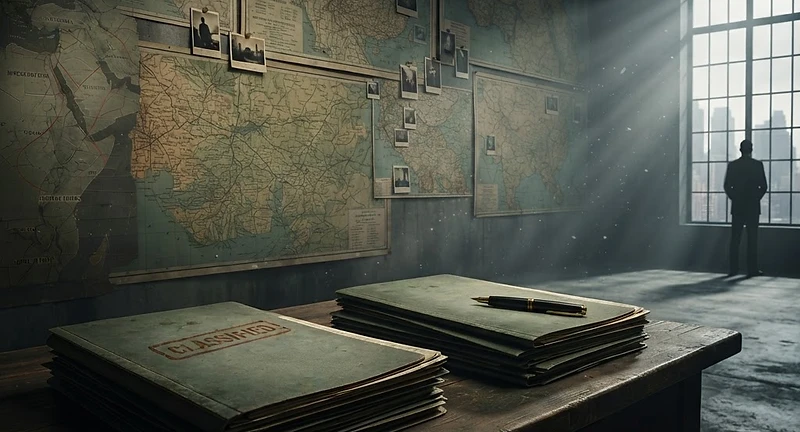
An epigraph opens the book like a blade: a power should sit on the mountain, let two tigers exhaust themselves fighting below, then descend to take what remains. Watching Tigers Fight is the story of that mountain, and of the people below who slowly, terribly, come to understand what it means to live inside someone else's patient design.
When young archivist Renn Cassik opens a file he was never meant to see, he uncovers a three-phase strategy called HARVEST: cultivate dependency, drain two rival powers through a war neither can win outright, and seize what remains once one giant collapses under its own exhausted weight. As the western war between Valdoria and Kreshnya grinds on, a handful of people across the world begin to glimpse the same terrible shape from different angles: a logistics officer who notices the shells are being spent too fast; a grain-store worker who realizes the weapons her country requests are bait; an intelligence analyst whose unauthorized column of numbers produces a date; and an aging diplomat who has spent forty years believing his quiet, patient work is mercy rather than theft.
Each of them sees clearly. None of them can stop what they see. Watching Tigers Fight is a geopolitical war novel about institutional blindness, moral compromise, and the devastating gap between knowing the truth and being permitted to act on it. It asks whether survival and complicity can ever be fully separated, whether strategic patience is a virtue or a crime, and whether insight is worth anything at all when the machinery of history has already decided the outcome.
Grave, intelligent, and quietly devastating, this novel builds its tension not through battlefield heroics but through the accumulation of documents, requisitions, intercepts, and silences, until the reader, like its characters, can no longer look away from the design. The cycle does not end when the harvest is complete. It only changes hands, and somewhere, another watcher is already counting.
✦A slow-burn geopolitical thriller where the real battlefield is spreadsheets, requisitions, and silence
✦Follows analysts, clerks, and soldiers who see the truth but cannot act on it, with devastating consequences
✦A patient, morally complex tragedy that asks whether peace can ever justify the price paid to buy it
If you enjoyed The Remains of the Day by Kazuo Ishiguro for its quiet moral reckoning, Tinker Tailor Soldier Spy by John le Carre for its patient institutional dread, or The Sympathizer by Viet Thanh Nguyen for its exploration of complicity and divided loyalty, you will love this book.
Get the Book
The order came at midday.
It came by runner, because the radios were for things that mattered more than orders to a single company, and the runner was a boy of perhaps nineteen who had run two kilometres of communication trench and arrived with his chest heaving and his eyes too bright, and he handed Sorel the folded paper and stood waiting to be told he could go, and Sorel read the order twice and then a third time and felt the stone in his stomach turn over.
The order was to take Hill 64.
Sorel knew Hill 64. Everyone on this part of the line knew Hill 64. It was a low rise of ground perhaps eight hundred metres forward of his position, and it had no value. That was not Sorel's opinion. It was a fact as solid as the arithmetic of the morning barrage. The hill commanded nothing, because the ground behind it fell away into marsh that no force could cross and no force would want to. It overlooked no road, no crossing, no town. It had been fought over twice in the last year, taken once by his own side and once by the enemy, and held by neither, because holding it required men and shells and both of those were worth more than the hill, and so each time it was taken it was abandoned within the week, and the only permanent residents of Hill 64 were the dead of both armies, who did not care who held it and were the only ones with any claim to.
And now he was to take it again.
He looked at the order. He looked at the place on the order where the reasoning should have been and was not, because orders did not carry reasoning, reasoning was a thing that happened above you and arrived only as consequence. He thought about the morning barrage, firing too fast, emptying the batteries as though there were no tomorrow. He thought about the order to take a hill worth nothing, an order that would cost him men he could not replace and shells the army could not replace, to gain a piece of ground that would be abandoned by the end of the month as it had been abandoned twice before.
And he understood, standing in the trench with the boy runner watching him and waiting to be dismissed, that the two things were the same thing. That somewhere above him, in the long rooms where men like the man he had once been moved numbers across maps, a decision had been made to spend. To spend shells, to spend men, to spend the substance of the army on hills that were worth nothing, and to do it fast, as though there were no tomorrow.
He did not understand why. That would come later, and it would come slowly, and by the time it came it would be too late to matter. For now he understood only the shape of it, the way he understood the shape of a barrage from its rhythm, and the shape of it was a hand reaching into a chest and taking out the heart by the fistful and throwing it away.
"Major?" the runner said.
"You can go," Sorel said. "Tell them the order is received."
The boy went. Sorel stood with the paper in his hand and looked east, toward the hill he could not see, and behind him the line waited, and the eleven veterans waited, and the boys whose names he had not learned waited, and above them all the silence pressed on the ear where the morning barrage had been.
He wrote the report that afternoon. He knew before he began it that no one would read it, and he wrote it anyway, because writing it was the only thing left that was his to do.
He wrote it carefully, in the flat clean language he had learned in the long rooms, the language that did not raise its voice because raising your voice was how you got dismissed as a man who had been too long on the line. He wrote down the rate of the morning barrage and what that rate implied about the stocks behind him. He wrote down the order to take Hill 64 and, without comment, the record of the two previous times the hill had been taken and abandoned. He set the two things side by side and let them sit there, the spending and the worthlessness of the thing being spent on, and he did not draw the conclusion, because drawing the conclusion was not his place and because the conclusion drew itself.
He called it a logistics assessment, because that was a thing a major was allowed to write, and he sent it up the chain by the afternoon runner, and he knew exactly what would happen to it. It would go up one level and be read by a man who was tired and had forty other papers, and the man would see that it was a logistics assessment from a major on the line, and he would file it, because logistics assessments from majors on the line were the dull weather of the war, and the weather was not something you acted on, it was something you endured.
It would be filed. It would go into a system, into a series, into a box, and the box would be sealed, and somewhere far away, in a place Sorel would never see, it would lie in the dark at a constant temperature, because paper had enemies and the worst of them was damp.
Sorel did not know that. He only knew that the report would not be read, and he wrote it anyway, and when it was gone he sat in the cold of the dugout and looked at the map of Hill 64, and he began, because it was his job and his men were his men, to plan how to spend them on a thing that was worth nothing, as carefully and as sparingly as a man can spend what he has been ordered to throw away.
An epigraph opens the book like a blade: a power should sit on the mountain, let two tigers exhaust themselves fighting below, then descend to take what remains. Watching Tigers Fight is the story of that mountain, and of the people below who slowly, terribly, come to understand what it means to liv
Who wrote Watching Tigers Fight?
Watching Tigers Fight was written by David Oldham.
Where can I buy Watching Tigers Fight?
Watching Tigers Fight is available for purchase on Amazon US, Amazon UK.
How many pages is Watching Tigers Fight?
Watching Tigers Fight has 383 pages.
When was Watching Tigers Fight published?
Watching Tigers Fight was published on September 16, 2026 by D&H Publishing International Ltd.
Can I read a sample of Watching Tigers Fight?
Yes, you can read a free sample of Watching Tigers Fight on AuthorCentral. An excerpt is available on the book page.