Rare Records, All-Nighters and the Northern Soul Movement
Beneath the industrial towns of northern England, a subculture was born from records the music industry had thrown away. The Faith Kept is a passionate, meticulously researched history of Northern Soul, the working-class movement that turned obscure American soul singles into the anthems of a lifetime and transformed sweaty basements and converted ballrooms into sacred ground. From the Twisted Wheel's black-painted walls to the sprung maple floor of Wigan Casino, from the seaside sessions at Blackpool Mecca to the coaches full of teenagers thundering up the M6 at two in the morning, Dave G Oldham traces the DJs, dancers, collectors and coach parties who built something no record label or promoter ever planned. This is a story of rarity and devotion: records that sold fifty copies in Ohio and went on to pack dance floors in Wigan a decade later, artists who discovered decades on that British audiences had never forgotten them, and a community that kept dancing long after the industry moved on. Oldham writes as both historian and lifelong participant, having first heard this music at a youth club in Prestwich in 1978 and never quite recovered. He does not flinch from the scene's harder edges, including its complicated relationship with amphetamines, nor does he treat the culture as a museum piece. Instead, he follows Northern Soul into weekenders, online marketplaces, TikTok and dance floors in Japan and Australia, showing how a scene built on seven-inch singles and all-night loyalty continues to recruit new generations. Part cultural history, part memoir, part love letter to the seven-inch single, The Faith Kept captures the sound, the sweat, the talcum powder and the enduring slogan that gives the book its title: Keep the Faith.
✦Vivid, sweat-soaked history of legendary clubs like the Twisted Wheel, Wigan Casino and Blackpool Mecca
✦Told by a lifelong participant, blending rigorous research with genuine insider passion
✦Explores rare records, athletic dance floors and a working-class culture that still thrives today
If you enjoyed Northern Soul: An Illustrated History by Elaine Constantine and Gareth Sweeney, or Wigan Casino by Russ Winstanley and David Nowell, you will love this book. Fans of Jon Savage's cultural histories of British youth movements, or Simon Reynolds' explorations of music subcultures, will find the same blend of scholarship and devotion here.
Get the Book
Nobody planned Northern Soul. Nobody sat down and designed it. There was no record label behind it, no promoter with a strategy, no journalist who wrote a manifesto and watched the kids follow. It just happened, the way the best things always do, in the gap between what the music industry thought people wanted and what a few thousand teenagers in the English Midlands and the North actually needed.
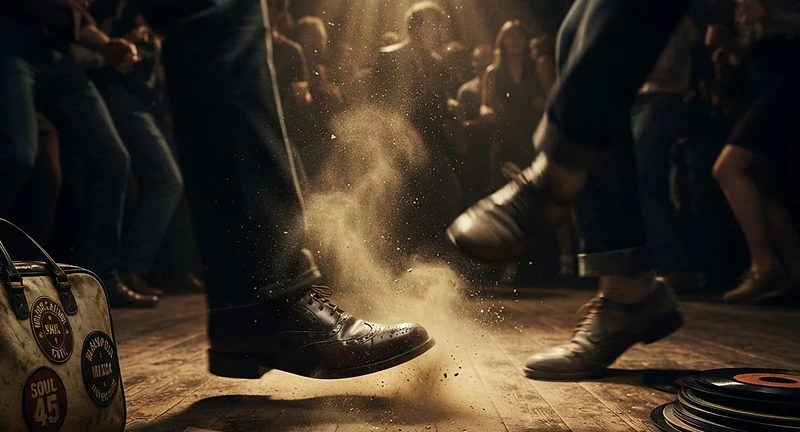
Picture a coach on the M6, autumn 1975. It's full of kids from Wolverhampton, from Stoke, from Crewe, from towns whose names don't appear in the music press. The girls are in wide-legged trousers and vests. The boys have got baggy Oxford bags and singlets, holdalls over their shoulders. Inside those bags: talcum powder, a fresh shirt, and in some cases a carefully wrapped seven-inch single bought that afternoon for more than a week's wages. They're heading to Wigan Casino to dance from two in the morning until eight. They wouldn't swap this night for anything in the world. Most of them have got work on Monday. They don't care.
That's Northern Soul. A music scene, a dance culture, a collecting obsession, and a way of life that's endured for more than half a century. It started in the late 1960s among working-class kids in the north of England and the Midlands, and it's never gone away. The idea at the centre of it is simple: the greatest dance music ever made was recorded by Black American artists in the mid-1960s, often on tiny independent labels, often in cities like Detroit, Chicago, and Philadelphia, and most of it was overlooked or forgotten in its own country. Northern Soul took those records and gave them a second life, six thousand miles from where they were made, in the sweaty cellars and converted ballrooms of industrial England.
The term was coined by Dave Godin, a London-based music journalist, record shop owner, and passionate advocate for Black American music. Godin ran Soul City, a specialist shop in Covent Garden, and wrote a regular column for Blues and Soul magazine. By the late 1960s, he'd noticed that customers travelling down from the north were asking for something quite different from what the London clubs wanted. The capital's scene was drifting towards funk, jazz-fusion, the newer sounds coming out of Philadelphia and Memphis. The northerners didn't want any of it. They wanted uptempo, beat-driven soul from the mid-1960s: pounding drums, soaring strings, impassioned vocals on records that had flopped on the American charts but were now filling dance floors from Manchester to Wolverhampton.
Godin started using the phrase 'Northern Soul' as a shorthand in his shop, telling his staff to point northern customers towards the bins of obscure American 45s they were after. In June 1970, in his Blues and Soul column, he used the term in print for the first time. It stuck. It gave a name to something that had been building for years, and it came to define a subculture that outlasted punk, outlasted acid house, and shows no sign of fading.
To understand Northern Soul, you need to understand what it isn't. It isn't 'oldies' music, though many of the records it celebrates were made in the 1960s. It isn't nostalgia, though memory and reverence for the past run deep in the culture. And it isn't, as casual observers have sometimes assumed, a niche interest for ageing collectors. Northern Soul is a living scene with active events in dozens of countries, new discoveries still being made in dusty record warehouses, and a younger generation of dancers learning the spins and drops that their parents perfected decades ago. I've seen teenagers at modern soul events dancing with the same intensity that Tash brought to that youth club floor in Prestwich in 1978. The steps get handed down. The feeling doesn't change.
The music runs on a driving four-four beat, typically between 100 and 130 beats per minute, heavy on bass and snare. The vocals are urgent, often pleading or celebratory, and the arrangements pile on lush strings and punchy brass. Think of Motown at its most energetic, then strip away the commercial polish. Records by Frank Wilson, Dean Parrish, Tobi Legend, and the Elgins became anthems on the Northern Soul circuit. The fact that they'd been ignored in the States only added to their mystique in the clubs of northern England. There's something beautiful about that. A record that sold fifty copies in Ohio in 1966 could pack a dance floor in Wigan a decade later. The music industry had decided these records were worthless. A few thousand kids in Lancashire disagreed.
Beneath the industrial towns of northern England, a subculture was born from records the music industry had thrown away. The Faith Kept is a passionate, meticulously researched history of Northern Soul, the working-class movement that turned obscure American soul singles into the anthems of a lifeti
Who wrote The Faith Kept?
The Faith Kept was written by David Oldham.
Where can I buy The Faith Kept?
The Faith Kept is available for purchase on Other, Amazon UK.
How many pages is The Faith Kept?
The Faith Kept has 215 pages.
When was The Faith Kept published?
The Faith Kept was published on September 26, 2026 by D&H Publishing International Ltd.
Can I read a sample of The Faith Kept?
Yes, you can read a free sample of The Faith Kept on AuthorCentral. An excerpt is available on the book page.