
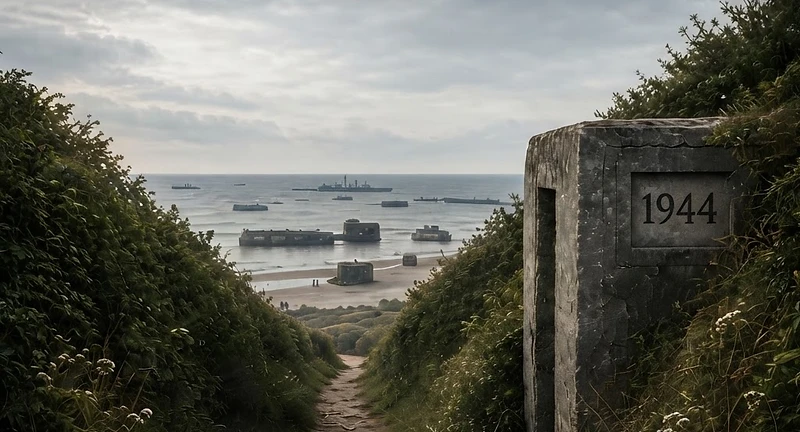
Walking in Their Footsteps

Walking in Their Footsteps

D-Day and the Ground They Fought On

On the morning of 6 June 1944, nearly seven thousand ships crossed the Channel and 156,000 men stormed the beaches of Normandy in the largest amphibious invasion in history. David Oldham has spent years living in the landscape where it happened, walking the beaches, the bocage, and the quiet crossroads that most visitors never find, and this book is the result: a history of D-Day and the Battle of Normandy told from the ground up. Beginning with the seeds of the Second World War in the ashes of Versailles, the book traces the long road to Overlord through the fall of France, the Blitz, Pearl Harbor, and four years of planning and deception, before delivering an hour-by-hour account of the landings at Utah, Omaha, Gold, Juno, and Sword. From there it follows the brutal battle through the hedgerows of the bocage, the ruins of Caen, the breakout at Saint-Lo, and the liberation of Paris, before turning to the letters, diaries, and voices left behind by the people who lived it, on both sides of the wire. Oldham writes not as a military historian but as a man who lives where it happened, standing on the bluffs above Omaha or in the fields above Mortain and letting the ground itself tell the story. Rich with the testimony of soldiers, resistance fighters, and civilians, and paired with a companion app that guides readers to over a hundred sites across Normandy, this is a book for anyone who wants to understand not just what happened on D-Day, but what it felt like, and why, eighty years on, it still matters.
  • ✦Walks you through Utah, Omaha, Gold, Juno, and Sword hour by hour, beach by beach
  • ✦Told by an author who lives in Normandy and has walked every site in the book
  • ✦Gives equal weight to generals and grenadiers, resistants and refugees, spies and civilians

If you enjoyed The Longest Day by Cornelius Ryan or D-Day by Antony Beevor, you will love this book, and readers of Stephen Ambrose's Band of Brothers will find the same grounded, human-scale storytelling here, combined with the intimate sense of place found in books written by authors who actually live where history happened.

Get the Book

There is a war memorial in almost every village in Mayenne. They stand in the squares and at the crossroads, grey stone columns or simple plaques bearing lists of names, and if you live here long enough you stop noticing them, the way you stop noticing road signs or postboxes. I stopped noticing them for a while. Then one afternoon, years ago now, I was walking our dog Milo through Colombiers-du-Plessis and I paused at the one near the mairie and read the names properly for the first time. Milo is gone now, but the memorial is still there, and the names are still on it, and what I thought that afternoon has stayed with me ever since. There were eleven of them for 1914 to 1918, from a commune that cannot have held more than a few hundred people. Eleven men from one tiny place in a part of France that saw no fighting at all. I stood there doing the arithmetic, thinking about the houses they had left and the families that waited and the gaps in the village that would never be filled, and I thought: this is where it starts. Not at Versailles, not in the corridors of power, but here, in a village square with eleven names on a stone, multiplied by every village in France, and Germany, and Belgium, and Britain. The peace that followed the First World War was built on grief so vast that the people who built it could not think clearly, and the treaty they produced at Versailles in 1919 was a document shaped more by exhaustion and fury than by wisdom. It showed. The Hall of Mirrors at the Palace of Versailles is a room designed to overwhelm. Seventeen arched windows face seventeen matching mirrors, and the light that pours through them on a summer afternoon fills the space with a brilliance that makes visitors squint. It was in this room, on 28 June 1919, that the leaders of the victorious Allied powers gathered to sign the treaty that would formally end the First World War. Outside, crowds pressed against the palace gates. Inside, the atmosphere was heavy with exhaustion, resentment, and the knowledge that what was being written into law would shape the century to come. The German delegation had been given no opportunity to negotiate. The terms were presented as a fait accompli, to be signed or rejected, and rejection would mean a resumption of the Allied naval blockade that had already brought Germany close to starvation. The treaty stripped Germany of thirteen per cent of its pre-war territory, including Alsace-Lorraine, the Saar coalfields, and all overseas colonies. The Rhineland was to be demilitarised. The army was capped at 100,000 men, the navy reduced to a token force, and the air force abolished entirely. Most bitterly of all, Article 231 assigned sole responsibility for the war to Germany and its allies, a clause that became known as the War Guilt provision and that many Germans regarded not as a legal formality but as a national humiliation. The German delegates signed. They had no choice. But in doing so, they set something in motion that the peacemakers in their finery could not foresee. The treaty was intended to prevent another war. Instead, it created the conditions for one.

More by David Oldham

Frequently Asked Questions

What is Walking in Their Footsteps about?

On the morning of 6 June 1944, nearly seven thousand ships crossed the Channel and 156,000 men stormed the beaches of Normandy in the largest amphibious invasion in history. David Oldham has spent years living in the landscape where it happened, walking the beaches, the bocage, and the quiet crossro

Who wrote Walking in Their Footsteps?

Walking in Their Footsteps was written by David Oldham.

Where can I buy Walking in Their Footsteps?

Walking in Their Footsteps is available for purchase on Amazon UK, Amazon US.

How many pages is Walking in Their Footsteps?

Walking in Their Footsteps has 317 pages.

When was Walking in Their Footsteps published?

Walking in Their Footsteps was published on September 6, 2026 by D&H Publishing International Ltd.

Can I read a sample of Walking in Their Footsteps?

Yes, you can read a free sample of Walking in Their Footsteps on AuthorCentral. An excerpt is available on the book page.

Share this book

Follow David Oldham

Get notified when David Oldham releases a new book.

Book Details

Language
English
Pages
317
Published
September 2026
ISBN (PB)
978-1918786583
ISBN (HB)
978-1918786569