
Rossendale Valley

Rossendale Valley

Built from Its Own Stone

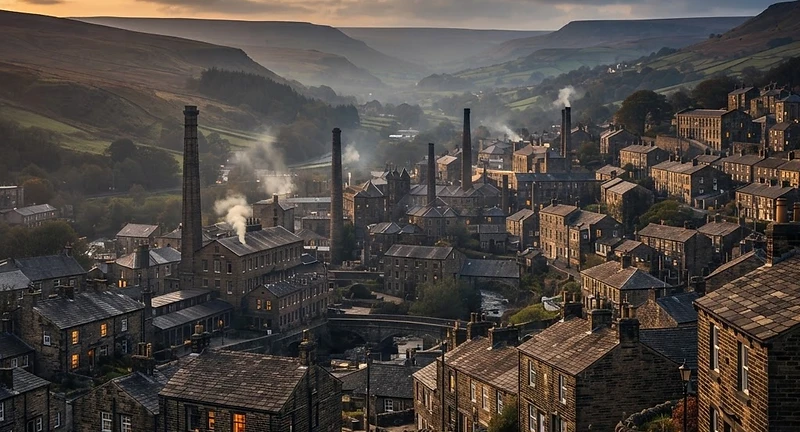
Speed along the M66 or the A56 through East Lancashire and Rossendale might look like nothing more than a road to somewhere else: stone terraces climbing steep hillsides, mill chimneys missing their tops, moors pressing in from both sides. But this valley was once one of the wealthiest corners of England, and its story is written into every street, chapel, and datestone if you know how to read it. David and Helen Oldham trace Rossendale's transformation from a medieval hunting forest, largely empty and legally controlled, into an industrial powerhouse whose cotton mills, quarries, and co-operative societies rivalled anywhere in Lancashire. Its stone paved Trafalgar Square. Its slipper trade, born from leftover felt in one man's kitchen in 1874, grew into an industry employing tens of thousands and exporting across the British Empire. Its people fought at Serre with the Accrington Pals, built chapels and libraries with their own hands, and rioted against machines that threatened their livelihoods. Combining rigorous documentary research with the authors' own connection to the valley, Helen's memories of working mills and changing communities alongside David's outsider curiosity, this book moves chronologically through ten chapters, from vaccaries and packhorse routes to twentieth-century decline and twenty-first-century regeneration. A timeline, glossary, sources, and practical visitor information turn the book into both history and guide, inviting readers to walk the valley themselves rather than simply pass through it. This is a story of self-reliance: a place that built its wealth, its institutions, and its identity from its own stone, its own water, and its own stubborn refusal to wait for anyone else to do it for them. Rossendale's importance far outstrips its present-day reputation, and this book makes the case, town by town, mill by mill, name by carved name.
  • ✦Discover the valley that punched above its weight: cotton, co-operatives, and a slipper trade that clothed an empire
  • ✦Meet the families whose carved names still mark doorways, barns, and chapels centuries later
  • ✦A practical companion as much as a history: walk the valley with museums, viewpoints, and memorials mapped out for you

If you enjoyed The Making of the English Landscape by W.G. Hoskins or Edgelands by Paul Farley and Michael Symmons Roberts, you will love this book. Readers of Common Ground by Rob Cowen and fans of Stuart Maconie's regional travel writing will also find much to admire in its blend of deep local history and personal, wry observation.

Meet the Authors

Get the Book

The first time I saw Rossendale, I thought it was the road to somewhere else. Helen had driven us up the M66, past Bury, past Ramsbottom, and into a valley that seemed to close in around us like a fist. Stone terraces climbed the hillsides in rows. Mill chimneys stood against the sky, some of them already missing their tops. The moors pressed down from both sides, dark and wet, and the river at the bottom of it all was the colour of tea. I remember thinking: people live here on purpose? Helen grew up here on purpose. She remembers the mills still working, just. She remembers the sound of the looms stopping for the last time and the arguments about what would happen next. She remembers the slipper factories holding on when everything else had gone, and the day they didn't hold on any more. She knows which pub has been three different pubs in her lifetime, where the corner shops used to be before they became takeaways or front rooms again, and which streets felt different after the families who gave them their names had all moved away or died out. She knows the smell of the valley when it rains, which is most of the time. She knows it the way you know a place that shaped you, which is to say she notices when something has gone, even when she can't always say exactly when it went. I came to it later, without that filter. What I saw was a landscape that didn't make sense unless you understood what had happened to it. Streets named after families I'd never heard of. Buildings too grand for the towns they were in. Gaps where buildings had been, filled with car parks or nothing. A railway that stopped halfway. A valley that clearly used to be something enormous and was now something that people drove through on the A56 or the M66 on their way to Burnley or Skipton or the Lakes, without stopping, without looking, without knowing what they were passing. That is what this book is about. Rossendale is not a single town. It is a valley, or more accurately a collection of valleys, running roughly east to west through the moors of East Lancashire. Rawtenstall is the largest town. Haslingden sits on the ridge to the south. Bacup anchors the eastern end, where the Irwell begins its long journey to Manchester. Between them, strung along the valley floor and up the side roads, are Waterfoot, Stacksteads, Crawshawbooth, Helmshore, Edenfield, Newchurch, Loveclough, and a dozen smaller places that merge into each other so gradually you sometimes can't tell where one ends and the next begins. For most of its history, this valley punched so far above its weight that the phrase barely covers it. The cotton mills here were among the most productive in Lancashire. The co-operative movement took root here before Rochdale made it famous. The slipper trade, born from leftover felt in one man's kitchen in 1874, grew into an industry that employed sixty thousand people and exported across the British Empire. The quarries sent Rossendale stone to build towns across the north. The money made here built seaside resorts, funded churches, endowed schools, and attracted foreign investors who placed advertisements in local newspapers asking Rossendale men to back their ventures. For a few extraordinary decades in the second half of the nineteenth century, this was one of the wealthiest corners of England. And then it wasn't.

More by David Oldham

Frequently Asked Questions

What is Rossendale Valley about?

Speed along the M66 or the A56 through East Lancashire and Rossendale might look like nothing more than a road to somewhere else: stone terraces climbing steep hillsides, mill chimneys missing their tops, moors pressing in from both sides. But this valley was once one of the wealthiest corners of En

Who wrote Rossendale Valley?

Rossendale Valley was written by David & Helen Oldham.

Where can I buy Rossendale Valley?

Rossendale Valley is available for purchase on Other.

Can I read a sample of Rossendale Valley?

Yes, you can read a free sample of Rossendale Valley on AuthorCentral. An excerpt is available on the book page.

Share this book

Follow David Oldham

Get notified when David Oldham releases a new book.

Book Details

Language
English
ISBN (PB)
978-1-918786-31-6
ISBN (HB)
978-1-918786-30-9