How Method, Discipline, and Teaching Shaped Global Cuisine
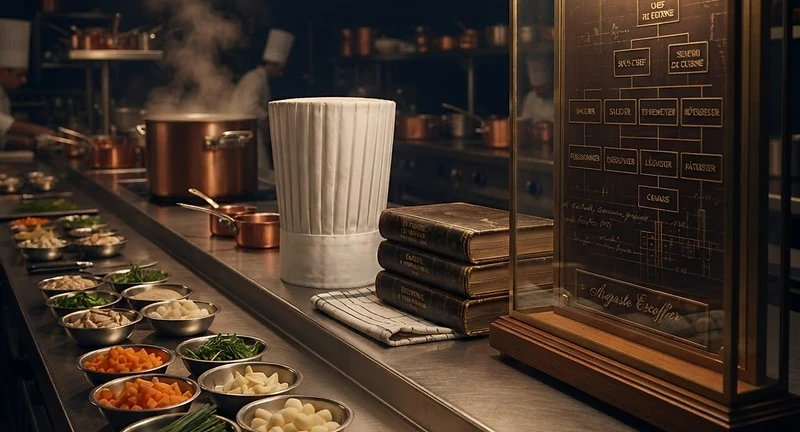
Why does a chef in Tokyo, a line cook in Chicago, and a hotel kitchen brigade in Dubai all speak the same culinary shorthand, brunoise, mise en place, sauté, regardless of what cuisine they actually cook? David G. Oldham argues that the answer has nothing to do with French food tasting better than anyone else's, and everything to do with France building something no other culinary tradition built: a complete, teachable, scalable system for organizing professional cooking. The French Kitchen System traces two centuries of institutional history, from the violent, unregulated chaos of pre-nineteenth-century kitchens through Auguste Escoffier's formalization of the brigade de cuisine in the 1890s, and on through the grand hotels, ocean liners, and colonial outposts where that system proved it could scale to any size or setting. Oldham follows the written texts, Le Guide Culinaire, Larousse Gastronomique, that turned oral apprenticeship wisdom into portable, permanent knowledge, and confronts the catastrophic disruptions of two world wars that tested whether a system built on abundance and precision could survive scarcity and occupation. The final chapters bring the story into the present, revealing how the brigade structure now organizes chain kitchens and catering operations worldwide, how French terminology remains the professional lingua franca even in kitchens that never touch French cuisine, and how Escoffier's codified techniques have quietly colonized home cooking through television, cookbooks, and online video. This is not a book about how good French food tastes. It is a rigorous, detail-driven account of how a craft became a discipline, and how that discipline conquered the world's kitchens. For anyone interested in institutional history, professional training, or the hidden architecture behind everyday cooking, this book reframes French cuisine's global dominance as a triumph of organization rather than flavor.
✦Reframes French cuisine's dominance as a story of systems and training, not superior taste
✦Traces two centuries of history from chaotic kitchens to Escoffier's brigade to today's global chains
✦Reveals how French technique and vocabulary secretly shape home cooking around the world
Readers who enjoyed Bill Buford's Heat, Michael Ruhlman's The Making of a Chef, and Mark Kurlansky's institutional food histories like Salt and Cod will find a similar appetite here for tracing craft into system. Fans of Rudolph Chelminski's The Perfectionist or Lisa Abend's The Sorcerer's Apprentices, books that examine the machinery behind culinary excellence rather than just its results, will recognize Oldham's approach to Escoffier and the brigade de cuisine as a natural companion read.
Get the Book
This is not a book about how good French food tastes. It is not a celebration of butter, wine, and technique elevated to art. It is not a love letter to Paris bistros, Provençal markets, or three-star temples of gastronomy. And it is emphatically not a recipe book.
What it is, instead, is an examination of something far less romantic but considerably more consequential: how one country's approach to organising professional cooking came to reshape kitchens across the entire world. The argument at its centre is straightforward. French cuisine achieved its extraordinary global influence not because it tastes better than other traditions (a claim that would be both unprovable and absurd), but because France developed a complete professional system for cooking that could be taught to strangers, repeated by people who had never met one another, evaluated against consistent standards, and scaled from a hotel kitchen in London to a cruise liner crossing the Atlantic to a restaurant in Shanghai. No other culinary tradition built anything comparable at the moment in history when the world needed exactly such a system.
That system has several interlocking components, and this book traces how each of them emerged, matured, survived disruption, and spread. There is the brigade de cuisine, the hierarchical kitchen structure that Auguste Escoffier formalised in the 1890s, which divided labour into specialised stations with clear chains of command. There is the codification of technique, the transformation of oral tradition and apprenticeship wisdom into written rules that anyone literate could study. There is the standardised professional vocabulary, the precise French terminology (brunoise, julienne, mise en place, sauté) that gave cooks everywhere a shared language free of ambiguity. And there is the formal training infrastructure, the network of culinary schools, apprenticeship programmes, and professional examinations that turned cooking from a trade you fell into to a career you prepared for.
None of these elements appeared overnight. The system took roughly two centuries to assemble, drawing on medieval guild traditions, the chaos that followed the French Revolution, the ambitions of grand hotel operators, the demands of ocean liners serving thousands, and the catastrophic disruptions of two world wars. Understanding how it came together requires looking at specific people, places, dates, and decisions rather than vague appeals to French cultural superiority.
This book proceeds chronologically. It begins with the messy, violent, largely unregulated kitchens that existed before the reforms of the late nineteenth century, when cooking in a professional kitchen was closer to manual labour in a furnace than to any notion of culinary artistry. It follows the pivotal career of Escoffier, who did not invent French cooking but who organised it into a system that could function reliably in the enormous kitchens of the Savoy and the Carlton. It traces how that system spread through hotels, ocean liners, railways, and colonial outposts, proving itself adaptable to wildly different scales and settings. It examines the written texts that anchored the system in permanent form, from Le Guide Culinaire to Larousse Gastronomique, and asks why having cooking written down mattered so profoundly for its transmission across borders.
To understand what the French kitchen system replaced, you first have to understand what existed before it. And what existed, for most of the history of cooking in France, was chaos. Not the picturesque chaos of bustling market squares and grandmothers stirring pots of cassoulet, but the grinding, dangerous, frequently brutal chaos of professional kitchens in which heat, alcohol, violence, and sheer physical exhaustion were the defining features of daily life. The system that Escoffier would later impose on this world did not emerge from a vacuum. It emerged from a desperate need for order in places where order had never existed.
Why does a chef in Tokyo, a line cook in Chicago, and a hotel kitchen brigade in Dubai all speak the same culinary shorthand, brunoise, mise en place, sauté, regardless of what cuisine they actually cook? David G. Oldham argues that the answer has nothing to do with French food tasting better than a
Who wrote The French Kitchen System?
The French Kitchen System was written by David Oldham.
Where can I buy The French Kitchen System?
The French Kitchen System is available for purchase on Other.
How many pages is The French Kitchen System?
The French Kitchen System has 439 pages.
When was The French Kitchen System published?
The French Kitchen System was published on September 28, 2026 by D&H Publishing International Ltd.
Can I read a sample of The French Kitchen System?
Yes, you can read a free sample of The French Kitchen System on AuthorCentral. An excerpt is available on the book page.