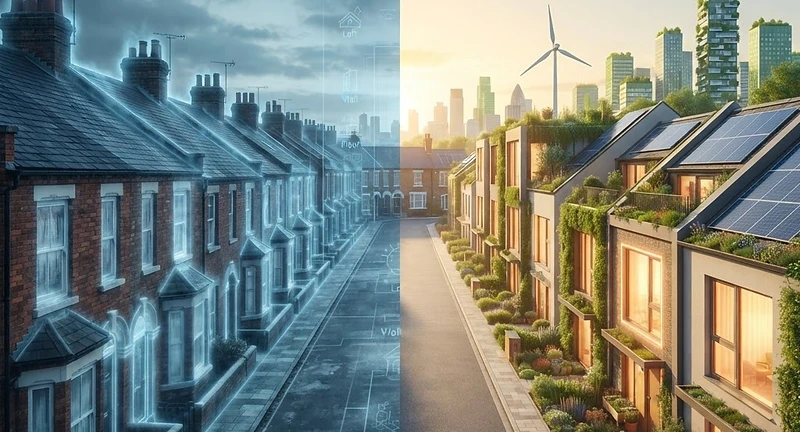
Every year, you lose thousands of pounds in wasted energy as heat leaks through your walls, roof, and floor. You have tried to manage the rising costs, but the chill remains, and the problem is only growing. Whether you live in a draughty Victorian terrace, a semi-detached house with empty cavities, or a newer home that just isn't performing, your building is currently costing you a fortune. This guide finally cuts through the industry jargon, the misleading government leaflets, and the unreliable online advice to give you the honest, practical facts you need. Learn how to diagnose your home’s specific heat-loss story, compare the pros and cons of internal versus external insulation, and understand the critical junction details that most builders ignore. Don't let your money bleed away through your walls for another winter. Discover how to transform your home into the comfortable, efficient, and cost-effective space it deserves to be.
✦Stop wasting money: Master the art of sealing your home to slash those rising energy bills immediately.
✦Cut the jargon: Finally receive clear, honest, and practical advice without the confusing industry fluff.
✦Solve the chill: Learn professional techniques to diagnose heat loss and transform your home into a cozy sanctuary.
If you enjoyed The Passivhaus Handbook by Adam Dadeby and Kirsty Orme or Renovation by Michael Litchfield, you will love this essential guide to modernizing your home.
Get the Book
Bought this book? Claim your free eBook
If you have already bought From Victorian Terraces to Passivhaus by David Oldham, tell us where to send it and we will email you the eBook version, free. You keep reading on any device.
Chapter 1 Why Your Home Is Losing Money Through Its Walls Stand inside a Victorian terrace on a January evening. The radiators are on, the thermostat reads twenty-one degrees, and the gas meter is spinning. Place your hand flat against the external wall. It is cold. Not cool, but genuinely cold. That wall, two hundred and twenty millimetres of solid brick with nothing behind it but a century of soot and paint, is conducting heat out of your home at a rate that would have been considered scandalous if anyone had bothered to measure it when the house was built. Nobody did, of course. The Victorians built for permanence, not thermal performance. Their terraces have survived two world From Victorian Terraces to Passivhaus 20 wars, a hundred winters, and the invention of central heating, which they never imagined. What they also never imagined was a world in which natural gas would cost six pence per kilowatt-hour and a typical household would spend over seventeen hundred pounds a year simply to keep the lights on and the rooms warm. Yet here we are. And if you own or live in one of the roughly twenty-nine million homes in England, Scotland, and Wales, there is a very good chance that your walls, your roof, and your floors are haemorrhaging heat, and money, in ways you can feel but cannot see. • • • The Scale of the Problem The United Kingdom has some of the oldest and least energy- efficient housing stock in Europe. Nearly ten million households are living in poorly insulated homes, and research suggests that UK houses lose heat up to three times faster than equivalent buildings in Scandinavia and Northern Europe. This is not merely an inconvenience. It is a national crisis with consequences that reach far beyond your energy bill. Consider the numbers. A typical uninsulated solid-wall home, and there are roughly four million of them still standing in Britain, loses about a third of its heat directly through the walls. Another From Victorian Terraces to Passivhaus 21 quarter disappears through the roof. Floors, windows, draughts, and ventilation account for the rest. In practical terms, a pre-1919 terrace with no insulation improvements can require fifteen thousand kilowatt-hours of gas per year for space heating alone, well above the national median and enough to push an annual energy bill past two thousand pounds. The houses built between the wars and through the post-war boom are better, but not by as much as you might think. A 1970s semi-detached house with unfilled cavity walls still loses heat at roughly double the rate that current Building Regulations consider acceptable. Multiply that across the six million or so cavity-wall homes that remain uninsulated, and you begin to understand why British homes, collectively, produce more carbon dioxide each year than all the cars on British roads. That last point is worth pausing over. England’s twenty-five million homes produce an estimated fifty-eight million tonnes of CO₂ annually, more than the fifty-six million tonnes from the country’s twenty-seven million cars. The single biggest reason is the combination of gas central heating and poor insulation: we burn fossil fuel to generate warmth, and then we let that warmth leak away through fabric that was never designed to hold it. • • • What It Costs You From Victorian Terraces to Passivhaus 22 As of early 2026, the Ofgem energy price cap sets the typical dual- fuel household bill at around £1,758 per year. That figure assumes medium consumption: roughly 11,500 kilowatt-hours of gas and 2,700 kilowatt-hours of electricity. If your home is poorly insulated, you are almost certainly above that average, potentially well above it. To put this in more tangible terms, an uninsulated solid wall with a U-value of around 2.0 W/m²K, a typical figure for a Victorian or Edwardian terrace, will lose roughly forty watts of heat per square metre for every twenty-degree difference between inside and outside temperature. Over a hundred square metres of wall area, which is a modest two-storey terrace, that is four thousand watts of continuous heat loss through the walls alone whenever it is cold outside. Over a heating season, that translates into thousands of kilowatt-hours of wasted gas and hundreds of pounds on your bill. Insulating those same walls to a U-value of 0.3 W/m²K, a realistic target for a solid-wall retrofit, reduces that loss by more than eighty per cent. In pounds and pence, that typically means savings of four hundred to six hundred pounds per year for a terraced house, and potentially more for a larger or more exposed property. A cavity-wall home seeing its empty cavities filled can expect savings of three hundred to five hundred pounds annually. From Victorian Terraces to Passivhaus 23 External insulation on a new build or deep retrofit can push savings higher still. These are not theoretical numbers plucked from laboratory conditions. They are based on standardised calculations using real U-values, real energy prices, and the real temperature differences that British winters deliver. And they take no account of the other financial benefits: reduced maintenance on a building that no longer suffers from condensation damage, a higher Energy Performance Certificate rating that adds value to your property, or eligibility for government grants that can cover a substantial portion of the upfront cost. • • • Beyond the Bill: Comfort, Health, and the Hidden Costs Energy savings are the headline, but they are not the whole story. Anyone who has lived in a poorly insulated house knows that the problem is not just financial. It is physical. Cold walls radiate chill into the room regardless of the air temperature. You can set your thermostat to twenty-one degrees and still feel cold sitting near an external wall, because your body is losing heat by radiation to that cold surface. This is why people in draughty Victorian houses often crank the heating higher than they need to, chasing a sense of warmth that the building’s fabric simply cannot deliver. From Victorian Terraces to Passivhaus 24 The health consequences are real and well documented. Six million households in the UK are estimated to be in fuel poverty, unable to adequately heat their homes without spending a disproportionate share of their income. Living in cold homes doubles the risk of developing new mental health conditions in adults and puts one in four children at risk of anxiety and depression symptoms. The physical toll includes increased cardiovascular risk, worsened respiratory conditions (particularly in damp, mould-prone homes) and impaired lung development in children. The NHS spends an estimated two and a half billion pounds per year treating illnesses directly linked to cold and damp housing. Proper insulation changes the character of a home. Wall surfaces that once sat at ten or twelve degrees in winter rise to seventeen or eighteen degrees. Cold spots and draughts at floor junctions and window reveals diminish or disappear. Condensation on cold walls, which is the precursor to mould, is dramatically reduced. The house feels warmer at a lower thermostat setting, which saves even more energy. These are quality-of-life improvements that do not appear in any payback calculation but matter enormously to the people living inside. • • • Why Now? From Victorian Terraces to Passivhaus 25 If poorly insulated homes have been a problem for decades, why is this book arriving now? Because several forces are converging that make the case for action more urgent, and more rewarding, than it has ever been. Energy prices are not going back to where they were. Before the energy crisis triggered by the invasion of Ukraine in 2022, a typical household bill sat around £1,200 per year. Even after the worst of the spike has passed, bills in early 2026 remain forty-five per cent higher than in the winter of 2021. Wholesale gas prices have stabilised but show little sign of the dramatic falls that would be needed to return bills to pre-crisis levels. Every pound you spend heating a poorly insulated house costs roughly fifty per cent more in real terms than it did five years ago. Building Regulations are tightening. Part L of the Building Regulations, which governs energy efficiency, was updated significantly in 2022 and again with the Future Homes Standard taking effect from 2025. New homes must now achieve dramatically lower carbon emissions. For renovations, the rules require that whenever you open up a wall, floor, or roof, you bring the insulation up to current standards. The direction of travel is clear: by 2030, the expectation is that all buildings, new and existing, will need to meet far more demanding thermal performance targets. Doing the work now, on your own terms and From Victorian Terraces to Passivhaus 26 timeline, is almost always preferable to doing it later under regulatory pressure. Government funding is available. The ECO4 scheme and the Great British Insulation Scheme between them provide billions of pounds in funding for home insulation upgrades, particularly for lower-income households and those in the least efficient properties. These schemes will not last forever, and eligibility criteria shift with each iteration. If your home qualifies, the financial case for acting now is compelling: grants can cover fifty to eighty per cent of the cost of cavity wall or loft insulation and make a meaningful dent in the cost of more expensive solid-wall treatments. Materials and methods are improving. The insulation industry has not stood still. Aerogel-based products that were exotic and unaffordable a decade ago are becoming increasingly viable for retrofit use. Vacuum insulated panels offer extraordinary thermal performance in minimal thickness. Bio-based materials like hemp and wood fibre provide excellent insulation with lower environmental impact. Installation techniques have improved too, with better understanding of moisture management, thermal bridging, and airtightness: the details that separate a good insulation job from one that creates more problems than it solves. The climate is changing, but your house still needs to be warm. British winters may be marginally milder on average than From Victorian Terraces to Passivhaus 27 they were thirty years ago, but they are also more volatile, with sharper cold snaps and more intense storms. A well-insulated home is more resilient: it holds its temperature longer during power cuts, resists wind-driven rain better when the external envelope is properly detailed, and copes with summer heat more effectively because insulation works both ways. Climate adaptation and energy efficiency are two sides of the same coin. • • • Three Houses, One Problem This book is structured around three building types that together represent the vast majority of British housing. They are not the only types, but they capture the essential challenges and illustrate the full range of insulation approaches. The Victorian Terrace represents the pre-1919 solid-wall house. Roughly one in five UK homes falls into this category. These are buildings with thick brick walls and no cavity, often with heritage significance and planning constraints that limit what can be done externally. They are among the hardest homes to insulate well, but also among those with the most to gain. Internal insulation is the typical approach, though external solutions using sympathetic materials are increasingly viable where regulations allow. From Victorian Terraces to Passivhaus 28 The 1970s Semi-Detached stands for the enormous stock of post-war cavity-wall houses that make up roughly a third of British homes. These buildings were constructed with a gap between the inner and outer walls, a gap that was originally left empty. Filling that cavity is one of the simplest and most cost-effective energy efficiency measures available, yet millions of these homes remain unfilled. The semi also illustrates the challenges of partial improvement: filling the cavity is a good start, but junctions, lintels, and window reveals can still leak heat unless they are addressed. The Modern Passivhaus represents the frontier of what is possible. These ultra-efficient new builds achieve such low heat loss that they barely need conventional heating at all. They illustrate the principles (continuous external insulation, meticulous elimination of thermal bridges, controlled ventilation) that all insulation work should aspire
What is From Victorian Terraces to Passivhaus about?
Every year, you lose thousands of pounds in wasted energy as heat leaks through your walls, roof, and floor. You have tried to manage the rising costs, but the chill remains, and the problem is only growing. Whether you live in a draughty Victorian terrace, a semi-detached house with empty cavities,
Who wrote From Victorian Terraces to Passivhaus?
From Victorian Terraces to Passivhaus was written by David Oldham.
What genre is From Victorian Terraces to Passivhaus?
From Victorian Terraces to Passivhaus is categorized as Self-Help, Technology, Nature & Environment.
Where can I buy From Victorian Terraces to Passivhaus?
From Victorian Terraces to Passivhaus is available for purchase on Other.
How many pages is From Victorian Terraces to Passivhaus?
From Victorian Terraces to Passivhaus has 150 pages.
When was From Victorian Terraces to Passivhaus published?
From Victorian Terraces to Passivhaus was published on September 24, 2026 by D&H Publishing International Ltd.
Can I read a sample of From Victorian Terraces to Passivhaus?
Yes, you can read a free sample of From Victorian Terraces to Passivhaus on AuthorCentral. An excerpt is available on the book page.