
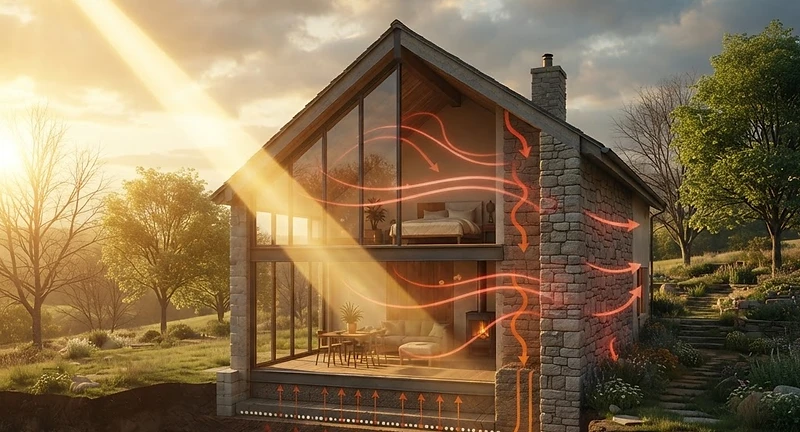


FREE HEAT
How Buildings Can Warm Themselves Using Sunlight, Mass & Earth
- ✦Master solar physics to slash your energy bills and eliminate the need for expensive mechanical heating systems.
- ✦Unlock professional design secrets like Trombe walls and thermal mass to naturally regulate your home temperature.
- ✦Gain practical, actionable guidance that transforms complex building science into simple, self-build strategies.
If you enjoyed The Passive Solar House by James Kachadorian or The Solar House by Daniel D. Chiras, you will love the practical and forward-thinking approach of this book.
Get the Book
Bought this book? Claim your free eBook
If you have already bought FREE HEAT by David Oldham, tell us where to send it and we will email you the eBook version, free. You keep reading on any device.
More by David Oldham

Biodiversity Net Gain

The Agitators

Die Agitatoren

Les Agitateurs

Gli Agitatori - Prima Scintilla

De Agitatoren

The Estate Generation

When the Lights Go Out

Ne mords pas la main qui te nourrit

The Day the Money Died

Patton's Road

La Última Gota

The Last Drop

Le Système de la Cuisine Française

Das System der französischen Küche

The French Kitchen System

The Faith Kept

Heaton Park

We are the Mods

From Victorian Terraces to Passivhaus

Liquid Power

Deviation Detected

Le Mans

From These Streets

Watching Tigers Fight

Wine and Attention

From these Streets

Walking in Their Footsteps

The River & The Owl

CHOKE

Not Manchester

The Listed Building Owner's Handbook

Mastering UK Building Regulations

Rossendale Valley

Le Mans
Frequently Asked Questions
What is FREE HEAT about?
For over a century, we have relied on mechanical systems to heat our buildings, burning through fuel and electricity while ignoring the fundamental physics of the sun. But there is a better way. This book offers a comprehensive guide to passive heating, a design philosophy that uses solar geometry,
Who wrote FREE HEAT?
FREE HEAT was written by David Oldham.
What genre is FREE HEAT?
FREE HEAT is categorized as Science, Nature & Environment, Technology.
Where can I buy FREE HEAT?
FREE HEAT is available for purchase on Other, Amazon.
How many pages is FREE HEAT?
FREE HEAT has 194 pages.
When was FREE HEAT published?
FREE HEAT was published on September 19, 2026 by D&H Publishing International Ltd.
Can I read a sample of FREE HEAT?
Yes, you can read a free sample of FREE HEAT on AuthorCentral. An excerpt is available on the book page.
Share this book
Follow David Oldham
Book Details
- Genre
- Science, Nature & Environment, Technology
- Language
- English
- Pages
- 194
- Published
- September 2026
- Publisher
- D&H Publishing International Ltd