
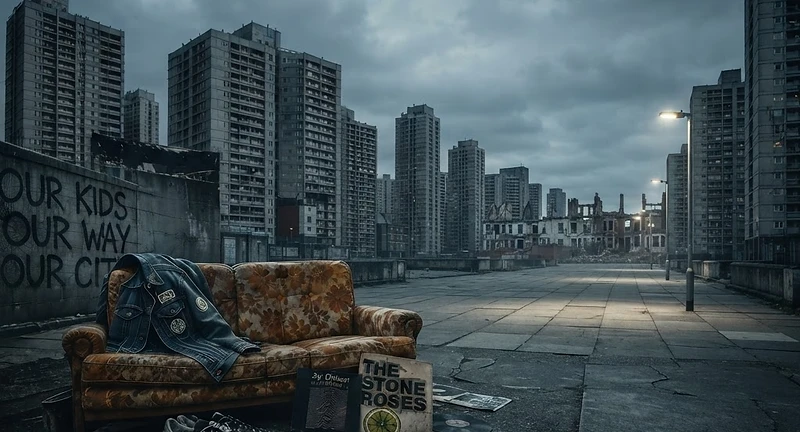
The Estate Generation

The Estate Generation

Music, Mania and Manchester's Council Estate Kids

Before the Hacienda. Before Factory Records. Before anyone had coined the word Madchester, there were council estates. Rows of new builds thrown up on the edges of a crumbling industrial city, filled with families uprooted from terraced streets that had stood for a hundred years. This is where David G. Oldham begins his story, not in a nightclub or a recording studio, but in a front room on William Street where he was born on a sofa in 1964. From there he traces the slow, uneven march of slum clearance across Manchester and Salford, the estates that kept their communities intact and the ones that scattered them to the wind, and the generation of kids who grew up in the gap between the two. It is a story about unemployment and empty hours, about giros and youth clubs with no money and parks with no swings, and about what happens when a generation with nothing to do finds music instead. Meticulously researched and told with the authority of someone who lived every brick and paving slab of it, The Estate Generation argues that Madchester was never really about the Hacienda or Tony Wilson's grand vision. It was about the estates themselves, the good ones and the bad ones, and the kids who came out of them. This is social history written from the ground up, a corrective to decades of music journalism that forgot where the music actually came from. Funny, angry, tender and unflinching, it is a tribute to the estate kids who built something from nothing and were never given a documentary of their own. For anyone who grew up on a council estate, who remembers the clearances, or who simply wants to understand where one of Britain's great musical explosions really began, this book is essential reading.
  • ✦A ground up social history of Madchester that starts decades before the music began
  • ✦Personal, honest storytelling from someone who actually lived the estate experience
  • ✦Reframes a world famous music scene as the product of housing policy and working class grit

Fans of Luke Bainbridge's The Illustrated History of Madchester, Simon Spence's The Stone Roses: War and Peace, and John Robb's The North Will Rise Again will find a lot to love here, as will readers of working class memoirs like Darren McGarvey's Poverty Safari that connect personal experience to wider social and political forces.

Get the Book

Bought this book? Claim your free eBook

If you have already bought The Estate Generation by David Oldham, tell us where to send it and we will email you the eBook version, free. You keep reading on any device.

We link your address to your visits here, so David Oldham can see what readers find useful. Unsubscribe any time.

Cheetham Hill in the early 1960s was rows and rows of Victorian terraces packed tight together. Two-up, two-downs with outside toilets and back yards where the washing hung between walls you could touch with both arms outstretched. Streets so narrow that if someone opened their front door on one side, you could practically shake hands with the woman doing the same thing opposite. They were cramped and cold and damp and nobody who lived in them would have called them comfortable. But they were something else too. They were a community. Everyone knew everyone. Doors were left open. Kids played in the street because there was nowhere else to play. If your mum needed a cup of sugar she didn't go to the shops, she went next door. And if your dad was out of work, which plenty of dads were, the neighbours didn't judge because half of them were in the same boat. I don't remember any of it. I was two when we left. But I've heard the stories enough times to know what was lost when the bulldozers came. They came for the terraces across the whole of Manchester and Salford in the 1960s, and they didn't stop until they'd flattened entire postcodes. The politicians called it slum clearance. The planners called it urban renewal. The people who lived in those streets had a different word for it, though most of them were too stunned to say it out loud at the time. What it was, plainly and simply, was the destruction of working-class communities that had existed for a hundred years, carried out by people who'd never lived in one. The logic was straightforward enough on paper. The terraces were old. Many of them lacked indoor plumbing. Some were genuinely unfit for habitation. The post-war housing drive had promised a new Britain, and that new Britain didn't have room for outside toilets and tin baths in front of the fire. So the councils drew lines on maps, served compulsory purchase orders, and moved thousands of families out of streets they'd lived in for generations and into brand new council estates on the edges of the city. Our family went from William Street to Rainsough Brow, a new estate perched on the hill between Prestwich and Kersal. New houses. Indoor bathroom. Central heating. Gardens. By every measurable standard, it was an improvement. And in many ways it was. My mum didn't miss the outside toilet. Nobody missed the damp. But something was missing, and it took a generation to understand what it was. Some of the new estates got it right, or close enough. Rainsough Brow had two pubs at the bottom, The Plough and The Staff of Life, and a row of shops at the top: a butcher, a hardware shop, Mr Southwood's newsagent that everyone called the paper shop, a greengrocer, and a Spar. More importantly, the council had the sense to move people from the same part of Cheetham Hill together, so families who'd been neighbours on the old terraces were neighbours again on the new estate. The community didn't die. It transplanted. People already knew each other. They looked out for each other the same way they always had, just with indoor plumbing and a bit more space between the walls. Not every estate was that lucky. Across Salford, the old streets around Regent Road were coming down. My Auntie Jean and her family were moved from there to Little Hulton, out on the western edge, miles from anywhere. Hulme's terraces were replaced by the Hulme Crescents, those brutalist deck-access monstrosities that were falling apart before the concrete had properly set. Collyhurst families were shipped out to Hattersley on the far side of Tameside. Where Rainsough had pubs and shops and familiar faces, these new developments had nothing. Communities that had been walking distance from the city centre found themselves stranded in places that didn't even have a decent bus service, surrounded by strangers.

More by David Oldham

Frequently Asked Questions

What is The Estate Generation about?

Before the Hacienda. Before Factory Records. Before anyone had coined the word Madchester, there were council estates. Rows of new builds thrown up on the edges of a crumbling industrial city, filled with families uprooted from terraced streets that had stood for a hundred years. This is where David

Who wrote The Estate Generation?

The Estate Generation was written by David Oldham.

Where can I buy The Estate Generation?

The Estate Generation is available for purchase on Other, Amazon UK.

When was The Estate Generation published?

The Estate Generation was published on October 21, 2026 by D&H Publishing International Ltd.

Can I read a sample of The Estate Generation?

Yes, you can read a free sample of The Estate Generation on AuthorCentral. An excerpt is available on the book page.

Share this book

Follow David Oldham

Get notified when David Oldham releases a new book.

Book Details

Language
English
Published
October 2026
Paperback ISBN
978-1918786231
Hardback ISBN
978-1918786224