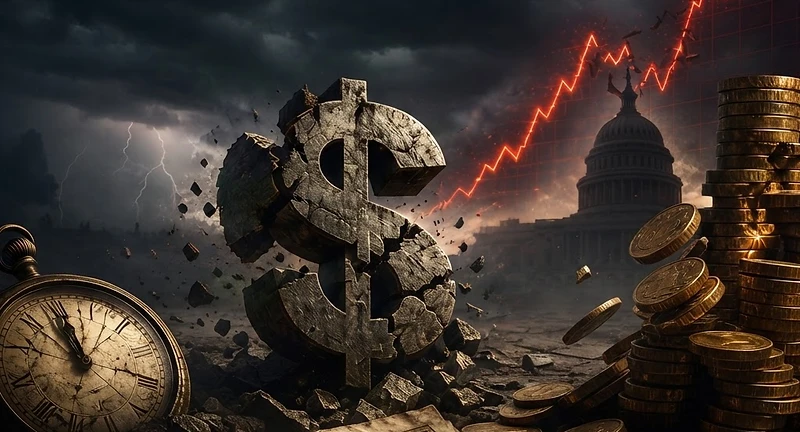
The world is running on borrowed time, and the bill is finally coming due. As sovereign debt levels explode across the globe, the comforting illusion that governments can spend without consequence is shattering. From the streets of Washington to the corridors of the European Central Bank, the machinery of our global economy has been driven by a dangerous, unsustainable cycle of debt accumulation, democratic apathy, and systemic fragility. This book pulls back the curtain on the opaque world of international finance to reveal the simple, harrowing arithmetic that threatens the future of every citizen. It exposes how the systems designed to safeguard our financial future have instead become the engines of our potential collapse. If you have ever wondered why prices continue to climb, why your savings feel less secure, or why the systems meant to protect you seem to be failing, this is the book you need to read now. The crisis is not a distant possibility, it is already unfolding, and the choices we make today will define the next century. Are you prepared for what happens when the music stops?
✦Unmask the truth behind global debt and the hidden forces driving today's rising prices.
✦Decode complex financial systems with simple arithmetic that reveals our economic reality.
✦Face the reality of systemic fragility before the bill for our borrowed time comes due.
If you enjoyed The Big Short by Michael Lewis or The Lords of Easy Money by Christopher Leonard, you will love this book for its gripping analysis of our precarious global financial landscape.
Get the Book
Bought this book? Claim your free eBook
If you have already bought The Day the Money Died by David Oldham, tell us where to send it and we will email you the eBook version, free. You keep reading on any device.
Chapter 1: The Magic Money Tree In 2017, during a televised election debate, a nurse told Theresa May that she hadn't had a real pay rise in eight years. She asked the Prime Minister how that could be justified. May's answer became one of the most quoted lines of that election, and probably of her entire premiership. “There isn't a magic money tree,” she said, “that we can shake that suddenly provides for everything that people want.” It was meant to sound responsible. Grown-up. Fiscally serious. The sort of thing a sensible leader says when difficult choices have to be made. The line was repeated by commentators, printed on placards, and thrown back at May in protests and on social media. To her critics, it sounded callous. To her supporters, it sounded honest. What nobody mentioned, because it would have made the whole moment rather awkward, was that it wasn't true. There is a magic money tree. There has been one for a very long time. Governments have been shaking it for decades, and the fruit it bears is called sovereign debt. 21 To understand where we are, which is standing at the edge of a financial cliff with forty trillion dollars of American IOUs fluttering in the wind, you have to understand what sovereign debt actually is. Not the version you get from politicians, which tends to involve a lot of hand-waving about investment and growth. Not the version you get from economists, which tends to involve equations that make your eyes glaze over before the second line. The real version. The one that explains how governments borrow money they can never repay, why they keep doing it, and why the whole arrangement hasn't collapsed already. Although, as we shall see, the “hasn't collapsed” part is increasingly a matter of opinion. The basic principle is simple enough. A government needs money. It needs money to pay for roads, hospitals, schools, soldiers, pensions, welfare, police, judges, diplomats, intelligence services, nuclear weapons, agricultural subsidies, disaster relief, and about ten thousand other things that modern citizens expect a functioning state to provide. The government raises most of this money through taxes. Income tax, corporation tax, sales tax, property tax, capital gains tax, inheritance tax, fuel duty, alcohol duty, tobacco duty, customs duties, and a few dozen more that most people have never heard of. In theory, the taxes should cover the spending. In practice, they almost never do. The gap between what a government collects and what it spends is called a deficit. And the way governments fill that gap is by borrowing. The Day the Money Died 22 When you or I borrow money, we go to a bank. We fill in forms. Someone checks our credit score, looks at our income, calculates whether we can afford the repayments, and decides whether to lend to us. If our finances are dodgy, we either get turned down or we pay a higher interest rate to compensate for the risk. The whole process is designed to make sure the lender gets their money back. When a government borrows money, none of that happens. A government borrows by issuing bonds. A bond is, in essence, an IOU. The government says: give me a thousand pounds today, and I will pay you back in ten years, plus interest along the way. Investors buy the bonds. The government gets the cash. Everyone is happy. Or at least, everyone is happy for now. The question you might reasonably ask is: who buys these bonds? Who, in their right mind, lends money to organisations that are already trillions in debt and show absolutely no sign of paying it back? The answer is: almost everyone. If you have a pension, you are lending money to a government. You may not know it. You may not have chosen it. But somewhere in the machinery of whatever fund is supposed to pay for your retirement, a significant portion of your money has been used to buy government bonds. Pension funds are among the largest holders of sovereign debt in the world. They The Day the Money Died 23 buy bonds because bonds are considered safe. They pay a predictable return. They don't swing wildly in value the way stocks do. And, most importantly, they are backed by the “full faith and credit” of a sovereign government, which is a fancy way of saying that the government promises to pay, and governments don't break promises. Except when they do. But we will get to that. Banks buy government bonds. Insurance companies buy them. Mutual funds and money market funds buy them. State and local governments buy them. Hedge funds buy them. Foreign governments buy them. In the United States alone, at the end of 2024, roughly $28.8 trillion in government debt was held by the public. Of that, about $8.5 trillion was held by foreign entities. Japan held roughly a trillion dollars of American government debt. China and Hong Kong held another trillion, though China has been quietly selling for years, reducing its holdings to about $693 billion by early 2026 and falling to third place among foreign investors. The Federal Reserve itself held $4.3 trillion. American mutual funds held $5.5 trillion. Commercial banks held $1.8 trillion. Your pension fund, your insurance company, your savings account, the money market fund where your employer parks its spare cash: all of them, in one way or another, are invested in the promise that the United States government will pay its debts. This is the first thing to understand about sovereign debt. It is not abstract. It is not a number on a screen in Washington. It is your retirement. It is the safety net under your bank account. It The Day the Money Died 24 is the foundation on which the entire financial system is built. When politicians talk about the national debt as though it were somebody else's problem, as though it were a matter of accounting that doesn't affect real people, they are either lying or they don't understand the system they are supposed to be running. Possibly both. Now here is where it gets interesting, and by interesting I mean terrifying. In a normal lending arrangement, the lender is someone who has money and wants to earn a return on it. The borrower is someone who needs money and is willing to pay interest for the privilege. The two parties are distinct. The lender has something the borrower wants. The borrower has to convince the lender that the loan is a good risk. In sovereign debt, this relationship has been corrupted beyond anything a normal person would recognise as sensible. The single largest buyer of government bonds in the modern era has been the government itself. Or, more precisely, the central bank, which is technically independent of the government but is in practice its financial arm. When the Federal Reserve buys US Treasury bonds, it is the American government lending money to the American government. When the Bank of England buys gilts, it is the British government lending money to the British government. When the European Central Bank buys eurozone sovereign debt, it is, The Day the Money Died 25 through a slightly more complicated chain of institutional plumbing, European governments lending money to European governments. This is quantitative easing, and if you have heard the term but never quite understood what it means, here is the short version: the central bank creates money out of thin air and uses it to buy the government's debt. Not metaphorically. Not through some complex financial mechanism that merely resembles creating money out of thin air. Literally. The central bank types a number into a computer, and that number becomes money. It then uses that money to buy bonds from banks and other financial institutions, which puts cash into the financial system and, conveniently, soaks up the government's debt at the same time. Before the 2008 financial crisis, the Federal Reserve's balance sheet stood at roughly $870 billion. That was the accumulated result of decades of careful, conservative central banking. By 2015, after three rounds of quantitative easing, it had ballooned to $4.5 trillion. Then came the pandemic. In March 2020, the Fed announced it would buy at least $500 billion in Treasury bonds and $200 billion in mortgage-backed securities. Within days, it dropped the word “at least” and went effectively unlimited. By the time the buying spree peaked, the Fed's balance sheet had reached nearly $9 trillion. From $870 billion to $9 trillion in less than fifteen years. An increase of more than tenfold. The Day the Money Died 26 The Bank of England did the same thing. The European Central Bank did the same thing. The Bank of Japan, which had been doing it since the early 2000s, did even more of it. Across the developed world, central banks created trillions of dollars, euros, pounds and yen and used the proceeds to buy their own governments' debt. The politicians called it stimulus. The central bankers called it unconventional monetary policy. A more honest description would be: we printed money because we didn't know what else to do, and we hoped nobody would notice. People noticed. The obvious question, the one that anyone who has not been trained in economics instinctively asks, is: if the government can just create money and lend it to itself, why do we pay taxes at all? Why not just print whatever we need? Why not just shake the magic money tree until every hospital is funded, every road is paved, every soldier is paid, and everyone gets a pony? The answer is inflation. And inflation, as we shall explore in detail later in this book, is not a theoretical risk. It is a tax. A silent, invisible, deeply regressive tax that falls hardest on the people who can least afford it. When you increase the supply of money without a corresponding increase in the supply of goods and services, prices go up. That is not an opinion. It is not a political The Day the Money Died 27 position. It is arithmetic. If there are a hundred loaves of bread and a hundred pounds in the economy, each loaf costs a pound. If you print another hundred pounds but there are still only a hundred loaves, each loaf costs two. The bread hasn't changed. Your money has simply become worth less. Central bankers spent years insisting that quantitative easing would not cause inflation. They had models. They had theories. They had historical comparisons that they believed supported their case. And for a while, they appeared to be right. Inflation stayed low through the 2010s, despite trillions in money creation. The central bankers congratulated themselves. The magic money tree, it seemed, bore fruit without consequence. Then came 2021 and 2022, and inflation arrived like a delayed bill from a restaurant you thought you'd sneaked out of. In the United States, inflation peaked at 9.1 per cent in June 2022. In the United Kingdom, it hit 11.1 per cent. In the eurozone, it touched 10.6 per cent. Food prices rose. Energy prices rose. Rents rose. The cost of everything that ordinary people need to survive went up, and the people who had printed the money that caused it went on television and called it “transitory.” It wasn't transitory. It was the bill. There is a clock in Manhattan, on the western side of the Bank of America Tower near Times Square, that displays the US national debt in real time. It was installed in 1989 by a The Day the Money Died 28 property developer named Seymour Durst, who was worried about the debt and wanted the public to see it. When the clock went up, the national debt was $2.7 trillion. Durst used to send Christmas cards to members of Congress showing their personal share of it. He died in 1995, and his family kept the clock running. In 2000, an unusual thing happened. Under the Clinton administration,
The world is running on borrowed time, and the bill is finally coming due. As sovereign debt levels explode across the globe, the comforting illusion that governments can spend without consequence is shattering. From the streets of Washington to the corridors of the European Central Bank, the machin
Who wrote The Day the Money Died?
The Day the Money Died was written by David Oldham.
What genre is The Day the Money Died?
The Day the Money Died is categorized as Politics, Business, History.
Where can I buy The Day the Money Died?
The Day the Money Died is available for purchase on Other.
How many pages is The Day the Money Died?
The Day the Money Died has 323 pages.
When was The Day the Money Died published?
The Day the Money Died was published on October 10, 2026 by D&H Publishing International Ltd.
Can I read a sample of The Day the Money Died?
Yes, you can read a free sample of The Day the Money Died on AuthorCentral. An excerpt is available on the book page.