The Story of a Generation That Refused to Be Ordinary
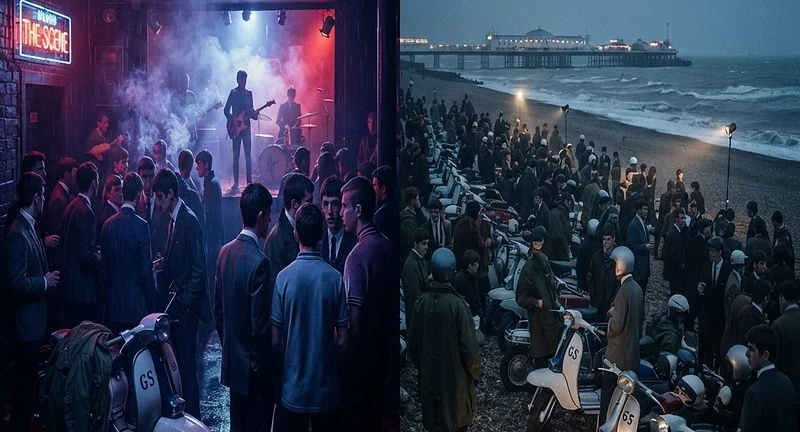
Before they were legends, they were working-class teenagers with nothing but pocket money and an obsession with looking right. They were the modernists, the architects of a style so sharp it cut through the grey silence of post-war Britain. From the smoky, condensation-dripping basements of Soho to the wind-swept beaches of Brighton, this is the story of a culture that refused to wait for permission to be extraordinary. Discover the true, unvarnished history of the movement that turned Italian tailoring, American R&B, and the humble motor scooter into a weapon against the mundane. This is not a fan tribute; it is a rigorous investigation into why this subculture persists, how it used fashion and music to redefine identity, and how it eventually collided with its own mythology. Whether you are a student of history or a fan of the style that never died, learn how this generation built a world of their own design. The music still plays, the rooms still fill, and the pursuit continues, are you ready to understand why?
✦Uncover the authentic, gritty history behind the sharp suits and scooters of the original Mod movement.
✦Experience the vibrant 1960s underground scene through a deep dive into the music and fashion that defined it.
✦Explore how a determined generation of teenagers used style as a weapon to escape the boredom of post-war Britain.
If you enjoyed England's Dreaming by Jon Savage or Subculture: The Meaning of Style by Dick Hebdige, you will find this rigorous examination of British youth identity both insightful and essential reading.
Get the Book
Bought this book? Claim your free eBook
If you have already bought We are the Mods by David Oldham, tell us where to send it and we will email you the eBook version, free. You keep reading on any device.
Chapter One: Before the Mods: Post-War Youth and the Birth of Cool Britain did not recover from the Second World War. It survived, which is a different thing entirely. The country that emerged blinking into peacetime was exhausted, bombed flat in places, rationed to the bone, and profoundly uncertain about what it was for anymore. Sweets stayed rationed until 1953. Meat until 1954. Bomb sites gaped like missing teeth along terraced streets from Stepney to Salford, and children played in the rubble because that was where the space was. The adults who had won the war wanted one thing above all else: for nothing dramatic to happen ever again. Their children had other plans. The generation born during or just after the war grew up in a peculiar limbo. Too young to remember the conflict, old enough to feel its aftermath in every aspect of daily life. Their parents' exhaustion was understandable but suffocating. The message, spoken and unspoken, was clear: be grateful, be quiet, know your place, get on with it. The rigid class structure that had briefly 13 wobbled under German bombs was being rebuilt brick by brick. If your father drove a delivery van, you would drive a delivery van. If your mother cleaned offices, you would clean offices. Ambition beyond your station was not merely discouraged; it was considered slightly vulgar. Into this grey stillness dropped American culture like a hand grenade. Rock and roll arrived first, blowing through British youth culture with the force of something genuinely new. Bill Haley's 'Rock Around the Clock' hit in 1955 and the effect was seismic, not because the music was sophisticated but because it was loud, physical, and utterly uninterested in respectability. Teenagers who had never been given a reason to make noise suddenly had one. Cinema seats were slashed. Dance halls shook. Respectable opinion was horrified, which was half the point. The first youth tribe to coalesce around this energy called themselves Teddy Boys. They appeared around 1953, and everything about them was a provocation. The drape jackets with velvet collars, the drainpipe trousers, the elaborate quiffs cemented with Brylcreem into sculptural defiance of gravity. The look was Edwardian, a deliberate theft of upper-class style from fifty years earlier, repurposed as working-class armour. It was brilliant in its own way. It said: fancy clothes are not just for toffs. It said: we exist, and we will not shut up about it. The Teds gathered on street corners and outside dance halls. They fought. They frightened people. The 1958 Notting Hill race riots, We are the Mods 14 in which groups of Teddy Boys attacked Caribbean immigrants, revealed a strain of violent racism running through the movement that no amount of stylish tailoring could excuse. The moral panic was intense, frequently absurd, and not entirely unjustified. But the Teddy Boys proved something that would matter enormously for what came next. They proved that young people had money, and that they wanted to spend it on clothes, music, and a social life their parents could not control. National Service was being phased out by the late 1950s. Wages were rising. Full employment meant a sixteen-year-old with a job could have real disposable income for the first time in British history. The teenager as a distinct consumer was being born, and the market was starting to pay attention. For a certain kind of young person, though, the Teds were the wrong answer to the right question. The Edwardian look was theatrical and aggressive, inseparable from a particular strain of working-class machismo that prized toughness above everything else. The music was exciting but crude, three chords and a shout. The whole scene felt limited, parochial, sealed off from the wider world. If you wanted something more than Saturday night violence and Sunday morning hangovers, the Teddy Boy movement was a dead end dressed in a drape jacket. The alternative was already forming in the basements of central London. Soho in the late 1950s was not respectable and did not pretend to be. Jazz clubs, strip joints, foreign restaurants, drinking dens of We are the Mods 15 variable legality: the square mile between Oxford Street and Shaftesbury Avenue operated by its own rules. It was London's designated zone of misbehaviour, and it attracted anyone who did not fit comfortably into mainstream British life. Bohemians, immigrants, musicians, petty criminals, homosexuals at a time when homosexuality was a criminal offence, and, increasingly, young people who sensed that something interesting was happening down those narrow streets. The jazz clubs were the key. Not the mainstream venues playing the big band swing their parents had danced to during the war, but smaller, darker rooms where the music was bebop and hard bop, complex and demanding, deliberately difficult. Charlie Parker. Dizzy Gillespie. Thelonious Monk. Miles Davis. The names circulated like passwords. To know them, to understand what made their music different from conventional jazz, was to identify yourself as someone who cared about artistic merit over easy entertainment, who had taste that ran deeper than the Top Twenty. These jazz enthusiasts began calling themselves modernists, borrowing the term from the art world. Modern because they embraced contemporary culture rather than nostalgia. Modern because they looked outward, to America and continental Europe, rather than backward to empire and tradition. Modern because they refused to accept that being young and British and working class meant you had to be unsophisticated. There were not many of them. A few hundred at most in those early years, scattered across a handful of venues. The Flamingo We are the Mods 16 on Wardour Street. The Marquee. Basement rooms with low ceilings and dubious wiring where the air was thick with cigarette smoke and the music was played at volumes that made conversation difficult and unnecessary. These places were not comfortable, not glamorous, not profitable. They were essential. The coffee bar completed the picture. Inspired by Italian cafe culture, these new establishments began appearing across London in the mid-1950s. The Moka Bar on Frith Street, opened in 1953 with a genuine Gaggia espresso machine, was among the first. Others followed: the Heaven and Hell, the Gyre and Gimble, the Partisan. They stayed open late, they served drinks that seemed impossibly continental compared to the universal British cup of tea, and they provided something that working-class teenagers desperately needed: somewhere to go that was neither home nor pub. The coffee bars mattered as symbols as much as social spaces. A teenager sitting over an espresso in a Soho coffee bar could imagine himself in Rome or Paris, part of a cosmopolitan world that bore no resemblance to the terraced street he had grown up on. It was fantasy, but it was accessible fantasy. You did not need money or connections. You needed the price of a coffee and a willingness to sit there as if you belonged. The jukebox in the corner played imported American records alongside British pop, and if you paid attention, you could hear things you would never hear on the BBC. Muddy Waters. Ray Charles. Music from a world your parents did not know existed. We are the Mods 17 American culture loomed over British youth in the 1950s like a neon sign visible from across the Atlantic. It represented everything Britain was not: wealthy, modern, optimistic, and apparently unshackled from the class system that determined your life chances before you were born. The America that mattered to the proto-Mods was not the America of Eisenhower and suburban conformity. It was Black America, specifically the music that Black Americans were creating: blues, rhythm and blues, early soul. This music reached Britain through circuitous routes. Servicemen stationed at British bases brought records. Merchant seamen returned from Atlantic crossings with rare imports purchased in New York and Baltimore. Radio Luxembourg, broadcasting from the continent, played American tracks the BBC would not touch. Specialist shops like Dobell's on Charing Cross Road sold imports at premium prices to anyone dedicated enough to seek them out. The attraction went deeper than the music itself. These were sounds created by a community that knew oppression intimately and had built beauty in response. The music was technically sophisticated but emotionally direct, meticulously crafted but alive with spontaneity. It offered an alternative model of masculinity that had no British equivalent: men who were emotional, sensual, and stylish without any sacrifice of power or presence. For working-class British teenagers raised on the stiff upper lip, this was a revelation. You could care about how you looked, how you moved, how you expressed yourself, and none of it made you less of a man. We are the Mods 18 American style filtered through in parallel. The casual elegance of Ivy League students in magazine photographs. The razor-sharp tailoring of jazz musicians on album covers. James Dean in a white T-shirt, making simplicity look like a radical act. British teenagers absorbed these images and began experimenting, adapting American ideas to British tailoring traditions and, without knowing it, creating the raw materials of something new. Class is the engine of this entire story, and it is worth being direct about it. The young men drifting towards the modernist scene in the late 1950s were overwhelmingly working class or lower-middle class. Office clerks, shop assistants, market traders, hairdressers, delivery drivers. They earned enough for clothes and entertainment but not enough for the traditional markers of middle-class arrival: a car, a house, a seat at the right table. What they could buy was style, and style became their currency. What separated these proto-Mods from the Teddy Boys was ambition of a particular kind. The Teds were aggressively, proudly working class, fighting against their limitations without any desire to transcend them. The early modernists wanted something different. They wanted to appear sophisticated, to possess the cultural knowledge and aesthetic confidence that was supposed to be the exclusive property of the educated middle classes. They studied style magazines. They taught themselves about modern jazz. They cultivated an air of cosmopolitan We are the Mods 19 detachment that would have been laughable if it had not been pursued with such earnest intensity. This was aspirational in the deepest sense. Not aspiration towards wealth, which remained largely out of reach, but aspiration towards a different way of being in the world. If you could not actually break through the class ceiling, you could at least build an alternative space underneath it where different rules applied. On a Soho dance floor at three in the morning, nobody cared about your accent or your father's job. What mattered was whether you could move, whether you understood the music, whether your clothes demonstrated knowledge and taste. For a few hours each week, status was earned rather than inherited. The transformation was temporary, but it was powerful enough to be worth everything it cost. The jobs themselves became part of the strategy. A young man working in a Soho menswear shop was not merely earning a wage; he was learning about fabric, cut, and construction while surrounded by the objects of his obsession. Employment close to the scene, however mundane, kept you geographically and culturally connected. Even the daily commute could serve double duty if your route took you past the right shops, the right streets, the right windows. By 1958, the raw materials were assembled. A generation with money and time. Dissatisfaction with both mainstream society and the existing youth tribes. Venues where the committed could We are the Mods 20 gather. Music worth rallying around. A growing appetite for European and American culture as antidotes to British provincialism. An aesthetic starting to coalesce around clean lines, careful tailoring, and continental cool. Nobody called it Mod yet. The scene was too small, too scattered, too underground to have cohered into anything with a name. But in a handful of clubs and coffee bars across central London, something was taking shape. Young men in sharp clothes were dancing to Black American music and talking about Italian suits and French cinema. They did
Before they were legends, they were working-class teenagers with nothing but pocket money and an obsession with looking right. They were the modernists, the architects of a style so sharp it cut through the grey silence of post-war Britain. From the smoky, condensation-dripping basements of Soho to
Who wrote We are the Mods?
We are the Mods was written by David Oldham.
What genre is We are the Mods?
We are the Mods is categorized as History, Music, Social Science.
Where can I buy We are the Mods?
We are the Mods is available for purchase on Other.
How many pages is We are the Mods?
We are the Mods has 257 pages.
When was We are the Mods published?
We are the Mods was published on September 25, 2026 by D&H Publishing International Ltd.
Can I read a sample of We are the Mods?
Yes, you can read a free sample of We are the Mods on AuthorCentral. An excerpt is available on the book page.