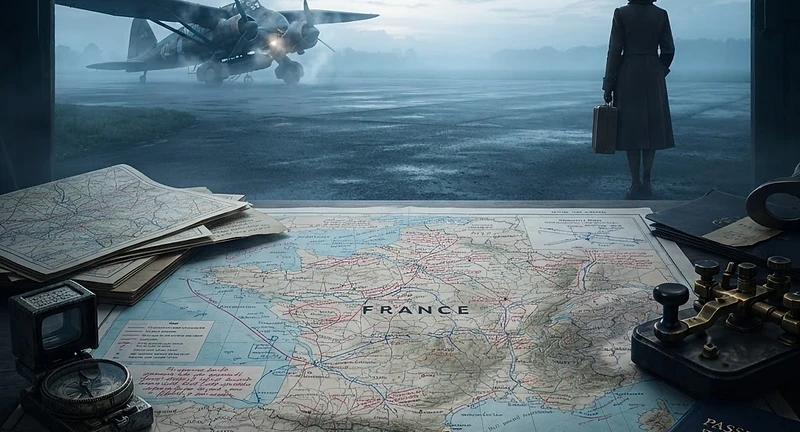
In the summer of 1940, with Britain standing alone and the war seemingly already lost, Winston Churchill ordered a new kind of warfare: irregular, deniable, and ruthless. Out of that desperation came the Special Operations Executive, and out of SOE came one of the war's best-kept secrets: the women who parachuted into occupied France to become couriers, wireless operators, and even circuit commanders in Hitler's most dangerous backyard.
The Women They Sent tells the true story of the thirty-nine women sent by F Section into Nazi-occupied France, women recruited in bare Whitehall offices by a novelist-turned-spymaster, trained alongside men in Highland killing schools, and dropped alone into a country where capture meant torture and almost certain death. Here are Odette Sansom, who endured the Gestapo's worst and gave nothing away; Noor Inayat Khan, the gentle mystic who kept a wireless link alive in Paris for three desperate months; Pearl Witherington, who took command of two thousand armed resistance fighters; and Vera Atkins, who spent years after the war hunting Nazi killers across the ruins of Germany to find out exactly what had happened to the women she had sent away.
Drawing on declassified files, war crimes testimony, and the accounts of survivors, Helen Oldham reconstructs the training, the tradecraft, the betrayals, and the unbearable courage of women who were written out of the official story of combat because no one believed women belonged there. Thirteen of them never came home. Their names were nearly lost to history, sealed behind official secrecy and a society eager to send them back to domestic silence.
This is a story of extraordinary bravery hidden behind the most ordinary disguises imaginable: a nurse's bicycle, a shopping basket, a bread queue. It restores to history the women Churchill's spies sent into the fire, and asks what it cost them, and what it should have earned them.
✦Uncovers the true, largely forgotten story of the thirty-nine women SOE sent into Nazi-occupied France
✦Combines the pace of a spy thriller with meticulous research into training, tradecraft, and betrayal
✦Gives voice to the thirteen women who never came home, and to Vera Atkins, who never stopped searching for them
If you enjoyed Sarah Helm's A Life in Secrets, Ben Macintyre's Agent Zigzag, or Kate Quinn's The Alice Network, you will love this book. Readers of Erik Larson's narrative histories and fans of Clare Mulley's The Spy Who Loved will find the same blend of rigorous research and page-turning drama that defines The Women They Sent.
Get the Book
The knock came without warning. It always came without warning. That was the point. The Gestapo did not telephone ahead. They did not send a letter. They arrived at the door, usually in the early morning when the target was still in bed, still half-asleep, still vulnerable in the way that only a person dragged from sleep can be. There were usually four or five of them, in plain clothes or in the black uniforms of the SS, and they carried pistols, and they did not ask permission to enter.
For the women of SOE who were captured in France, the moment of arrest was the dividing line of their lives. Everything that came before, the training, the recruitment, the months of clandestine work, the careful construction of a false identity, belonged to one world. Everything that came after, the interrogation, the imprisonment, the deportation, belonged to another. The transition between the two was instantaneous and absolute, and no amount of preparation could soften the shock of it.
The training at Beaulieu had included instruction on what to do if captured. The guidance was clear: resist interrogation for as long as possible, ideally for at least forty-eight hours, to give the other members of the circuit time to disperse, evacuate safe houses, and destroy incriminating material. Maintain the cover story for as long as it remained credible. If the cover story collapsed, admit nothing beyond name, rank, and the most basic personal details. Give the enemy nothing that could be used to identify, locate, or compromise other agents. Buy time. Endure.
The guidance was sound. It was also, as every captured agent discovered, almost impossibly difficult to follow when the interrogators at Avenue Foch or the Rue des Saussaies began their work.
The Gestapo headquarters at 84 Avenue Foch in Paris was the place where most captured SOE agents in northern France were taken for initial interrogation. It was a handsome building on one of the grandest avenues in the city, requisitioned from its owners and converted, with the bureaucratic efficiency that characterised the German occupation, into a centre for the interrogation and processing of suspected spies, resistance fighters, and enemies of the Reich.
The building's elegance was deliberate. The interrogation rooms on the upper floors were furnished with comfortable chairs, carpets, and curtains. Tea or coffee might be offered. The interrogators, many of whom spoke excellent French and some of whom spoke English, could be polite, even charming, in the opening stages of an interview. The contrast between the civilised surroundings and the violence that the interrogators were prepared to use was itself a technique: a way of destabilising the prisoner, of creating a sense of unreality that made resistance more difficult. A woman who had steeled herself for brutality might find the courtesy more unsettling than the blow.
The courtesy did not last. If the initial approach failed to produce useful information, the interrogation shifted to more direct methods. The methods varied, but the principles were consistent: the application of physical pain, psychological pressure, and the sustained destruction of the prisoner's sense of control, autonomy, and hope. The interrogators were professionals. They had been trained in the techniques of coercive questioning, and they applied them with a systematic thoroughness that left little room for heroic resistance.
In the summer of 1940, with Britain standing alone and the war seemingly already lost, Winston Churchill ordered a new kind of warfare: irregular, deniable, and ruthless. Out of that desperation came the Special Operations Executive, and out of SOE came one of the war's best-kept secrets: the women
Who wrote The Women They Sent?
The Women They Sent was written by Helen Oldham.
Where can I buy The Women They Sent?
The Women They Sent is available for purchase on Amazon UK, Amazon US.
How many pages is The Women They Sent?
The Women They Sent has 183 pages.
When was The Women They Sent published?
The Women They Sent was published on August 20, 2026 by D&H Publishing International Ltd.
Can I read a sample of The Women They Sent?
Yes, you can read a free sample of The Women They Sent on AuthorCentral. An excerpt is available on the book page.