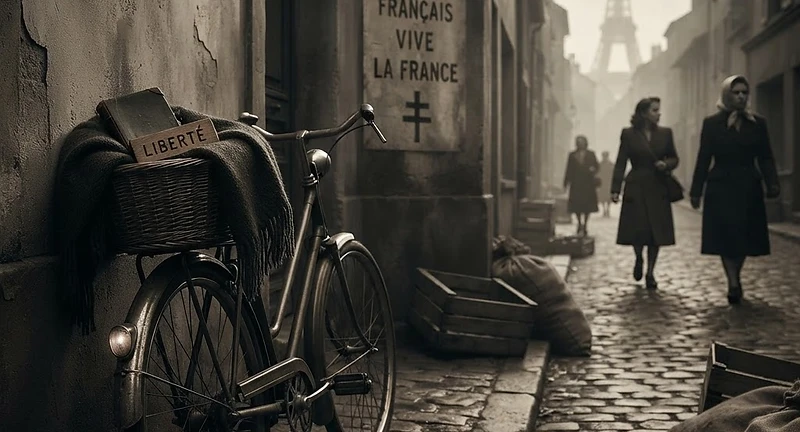
When France fell in six weeks in the summer of 1940, the men who might have fought back were dead, captured, or vanishing into German prisoner-of-war camps by the million. What was left was a nation of women, and it was women who quietly, stubbornly refused to accept defeat as final. This is their story, told through the lives of the famous and the forgotten alike.
Here is Marie-Madeleine Fourcade, who ran France's largest spy network from the back of a bicycle and escaped the Gestapo twice, once by stripping naked and forcing herself between the bars of her cell. Here is Nancy Wake, the White Mouse, who cycled five hundred kilometres in seventy-two hours to save her network and killed an SS sentry with her bare hands. Here is Violette Szabo, a Brixton shop girl turned SOE agent who fought the SS to a standstill with a Sten gun before her capture and execution at twenty-three. Here is Lucie Aubrac, five months pregnant, orchestrating an armed ambush to free her husband from a Gestapo convoy.
But this book is equally devoted to the women history nearly lost: the farmers' wives who cheated German requisition officers out of millions of litres of milk, the nurses who operated by candlelight in caves and barns, the couriers who carried forged papers inside hollowed-out loaves of bread, and the mothers who hid Jewish children and taught them new names, new prayers, new lives.
Drawn from memoirs, trial transcripts, and declassified files, The Women of the French Resistance restores these women to their rightful place at the centre of one of the twentieth century's defining struggles. It is a story of betrayal and survival, of silence and rediscovery, and of ordinary courage exercised by women who never expected to be called heroes.
✦Meet the real spies, saboteurs and couriers whose courage rivalled any thriller heroine
✦Gripping true stories of torture, escape and defiance drawn from testimony and declassified files
✦Rediscover the forgotten women written out of history for seventy years, finally given their due
If you enjoyed Sonia Purnell's A Woman of No Importance, Lynne Olson's Madame Fourcade's Secret War, or Anne Sebba's Les Parisiennes, you will love this book.
Get the Book
On the night of the twenty-ninth of April 1944, a woman in her early thirties jumped from an aircraft into the darkness over the Auvergne. Her parachute caught in a tree. A French Resistance leader named Henri Tardivat found her dangling from the branches and, with characteristic Gallic gallantry, remarked: "I hope that all the trees in France bear such beautiful fruit this year." She looked down at him and said: "Don't give me that French rubbish. Get me out of this tree."
This was Nancy Wake's return to France. She had left the country a year earlier as a fugitive, with a five-million-franc bounty on her head, her face on wanted posters across the south, and the Gestapo closing in from every direction. She was coming back with a set of false papers, a list of targets to destroy before the Allied invasion, and a determination that had not softened by a single degree. The Germans had called her the White Mouse because she slipped through their traps so many times. She took the nickname as a compliment.
She was born Nancy Grace Augusta Wake in Wellington, New Zealand, on the thirtieth of August 1912, the youngest of six children. Her family moved to Sydney when she was two, and her father abandoned them shortly afterwards, leaving her mother to raise the children alone. Wake grew up in relative poverty and with a fierce independence that her circumstances could not contain. She left home at sixteen, trained as a nurse, and with two hundred pounds inherited from an aunt, travelled to New York and then to London, where she taught herself journalism and shorthand.
By the early 1930s she was working as a freelance reporter in Europe. In Vienna, she witnessed something that changed the course of her life. She saw gangs of Nazi sympathisers chain Jewish men and women to large wheels and force them to scrub the streets on their knees while crowds gathered to jeer and spit. The image stayed with her. "From that moment," she said later, "I knew I would fight them with every ounce of strength I had. I knew what they were, and I knew they had to be stopped."
By 1937 she was living in Marseille, married to Henri Fiocca, a wealthy French industrialist who adored her. They lived well. She was beautiful, charming, and socially confident, the kind of woman who could hold a room and make every person in it feel that she was speaking only to them. When France fell in 1940, she might have chosen safety. She had money, connections, and a husband who would have done anything to protect her. She chose the opposite.
Wake threw herself into resistance work with the same energy she brought to everything else. She joined one of the earliest escape networks in the south, helping to smuggle downed Allied airmen out of France and into neutral Spain. Airmen had to be collected from hiding places, given false papers, escorted through checkpoints, and guided across the Pyrenees. Wake sheltered fugitives in her own home, bribed officials, charmed German officers at dinner parties while concealing intelligence in her handbag, and bought an ambulance to ferry refugees.
Her boldness became legendary even among people who were themselves taking extraordinary risks. On one occasion she was stopped by a German patrol while escorting a group of fugitives. Instead of freezing or running, she scolded the soldiers for delaying her, insisting with magnificent indignation that she was late for a dinner engagement. Her confidence was so complete, so entirely without hesitation, that they waved her through. Behind her walked the men whose lives depended on the performance she had just given.
When France fell in six weeks in the summer of 1940, the men who might have fought back were dead, captured, or vanishing into German prisoner-of-war camps by the million. What was left was a nation of women, and it was women who quietly, stubbornly refused to accept defeat as final. This is their s
Who wrote The Women of the French Resistance?
The Women of the French Resistance was written by Helen Oldham.
Where can I buy The Women of the French Resistance?
The Women of the French Resistance is available for purchase on Amazon US, Amazon UK.
How many pages is The Women of the French Resistance?
The Women of the French Resistance has 191 pages.
When was The Women of the French Resistance published?
The Women of the French Resistance was published on September 10, 2025 by D&H Publishing International Ltd.
Can I read a sample of The Women of the French Resistance?
Yes, you can read a free sample of The Women of the French Resistance on AuthorCentral. An excerpt is available on the book page.