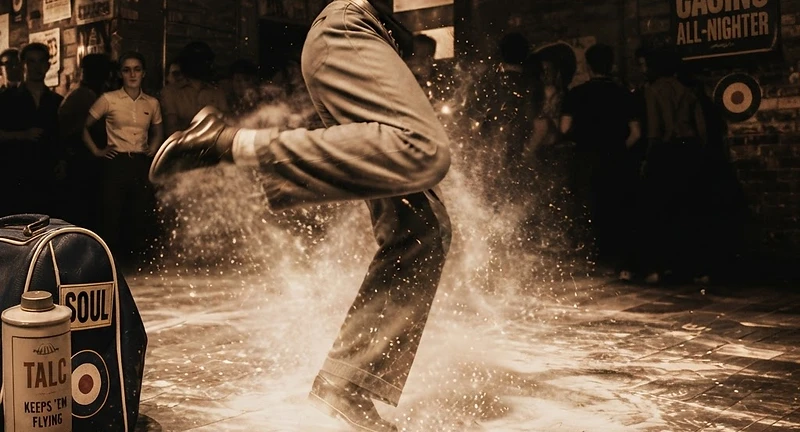
For over fifty years, an underground obsession has thrived in the industrial heartlands of Britain, defying every commercial trend and musical shift. From the sweat-drenched basements of the Twisted Wheel to the legendary all-nighters at Wigan Casino, this is the story of a community built on rare American soul records and the desperate need to dance until dawn. This book takes you beyond the records and the venues to reveal the soul of the scene. It explores the obsessive collecting, the athletic dancefloor styles, and the fierce dedication of those who kept the faith through decades of club closures and cultural change. Whether you are a veteran of the all-nighter or a curious newcomer, you will gain a deeper understanding of why this music still demands total devotion. Step into the circle and discover how a local movement grew into a global, lifelong passion that refuses to be forgotten.
✦Uncover the grit and glory behind the legendary dancehalls that defined a generation.
✦Experience the obsessive culture of vinyl collecting and the fierce devotion of the Northern Soul scene.
✦Relive the electric energy of all-nighters through evocative storytelling and historical research.
If you enjoyed Soul Survivors by Russell Percival or Last Night a DJ Saved My Life by Bill Brewster and Frank Broughton, you will love Northern Soul for its deep dive into the heart of British music culture.
Get the Book
Bought this book? Claim your free eBook
If you have already bought Northern Soul by Keith Thompson-Ferguson, tell us where to send it and we will email you the eBook version, free. You keep reading on any device.
Chapter 1: What is Northern
Soul?
Northern Soul is more than a style of music. It's a culture, a
community, and for many, a lifelong obsession. Not a hobby. Not
a phase. An obsession. At its heart lies a love for a very specific
kind of sound: fast-paced, emotive, danceable soul records,
usually recorded in the United States during the 1960s, and often
by artists who never saw a penny of commercial success in their
own country. These songs, pressed onto obscure 45 rpm singles
and imported across the Atlantic, became the lifeblood of an
underground scene that found its strongest home in the industrial
towns and cities of Northern England.
The term “Northern Soul” was first coined in 1970 by music
journalist Dave Godin. Working at his Soul City record shop in
London, he noticed that northern football fans travelling south to
games would buy up-tempo Motown-style tracks, ignoring the
slower, funkier records that were becoming popular in the capital.
Godin used the phrase in Blues and Soul magazine, and it stuck.
He probably had no idea he was naming a movement that would
still be going strong half a century later.
At its peak, Northern Soul was a way of life. Fans - “soulies” to
those in the know - would travel for hours by car, bus or even
hitchhiking, just to spend a night dancing at a favourite club. The
music was played loud and late, often in venues that stayed open
until dawn. The atmosphere was something you had to feel to
believe: talcum powder scattered across wooden floors to aid
sliding spins, records played back-to-back by DJs determined to
outdo each other with ever-rarer tracks, and dancers performing
routines that were as athletic as they were stylish. Backdrops,
spins, drops - moves that would make a gymnast think twice. And
they were doing it at three in the morning, soaked in sweat,
running on nothing but adrenaline and devotion.
Northern Soul was never simply about music. It was about escape:
from the working week, from economic hardship, and from the
greyness of 1970s Britain. For many, it offered a world of
glamour and intensity, built on the energy of all-night dancing and
the thrill of discovering the next unheard American soul
masterpiece. You worked all week in a factory, a warehouse, a
shop floor. Then on Saturday night you climbed into a mate's car,
drove a hundred miles, and for a few hours you were somebody.
The music said you mattered. The dancefloor proved it.
Unlike other youth movements, Northern Soul was fiercely
independent and refused to be dictated by fashion trends or
commercial forces. Mods, Rockers, Punks and New Romantics
each had their uniforms and their pop idols, but Northern Soul
Northern Soul
18
was something different. It had no single chart-topping band or
glossy magazine to represent it. The stars were often the DJs who
found the records, and the community valued authenticity above
all else. To dance to a track that only a handful of people owned
was a badge of honour. This search for the rare, the overlooked
and the almost forgotten gave Northern Soul its unique edge. It
wasn't about following what everyone else was listening to. It was
about discovering something special that spoke directly to the
heart. Try explaining that to someone who thinks music starts and
ends with Spotify.
Just as importantly, Northern Soul created a powerful sense of
belonging. In towns scarred by factory closures, unemployment
and long weeks of shift work, the clubs became sanctuaries. For
one night a week, people could shed the weight of the outside
world and lose themselves in the music. There was little room for
division once you were on the floor: everyone was equal under
the lights, united by the same rhythm. Stories are still told of
friendships forged on dancefloors that lasted a lifetime, and of
strangers offering lifts home to fellow travellers simply because
they recognised the patched baggy trousers or the clenched-fist
badge of a kindred soul fan.
What makes Northern Soul remarkable is its longevity. While
other youth movements have burned brightly and faded, this one
has endured for over half a century. Punk lasted what, five years
in its original form? Britpop barely managed three. Northern Soul
has reinvented itself across generations, found homes in Europe,
Japan and beyond, and even today draws crowds of both veterans
For over fifty years, an underground obsession has thrived in the industrial heartlands of Britain, defying every commercial trend and musical shift. From the sweat-drenched basements of the Twisted Wheel to the legendary all-nighters at Wigan Casino, this is the story of a community built on rare A
Who wrote Northern Soul?
Northern Soul was written by Keith Thompson-Ferguson.
What genre is Northern Soul?
Northern Soul is categorized as Music, History, Biography.
Where can I buy Northern Soul?
Northern Soul is available for purchase on Other, Amazon.
How many pages is Northern Soul?
Northern Soul has 171 pages.
When was Northern Soul published?
Northern Soul was published on October 25, 2026 by D&H Publishing International Ltd.
Can I read a sample of Northern Soul?
Yes, you can read a free sample of Northern Soul on AuthorCentral. An excerpt is available on the book page.